At The Quiet In The Land, they have a nice biography of Lao artisan Manivong Khattiyarat, where they contend he is one of the most important Lao artists of his time. It may be worthwhile for visitors to Luang Prabang with an appreciation for art to seek out examples of his work. Due to the fragile nature of the Internet when it comes to preserving Lao artist biographies, it is reproduced here:
"An Homage to Acharn Manivong Khattiyarat"
Manivong Khattiyarat, commonly known as “Acharn Manivong” (“Master Manivong”), is one of the most important Lao artists of his time. He exemplifies the Lao tradition of the nak ork beb—the creative person who provides others with an artistic model and vision. For his entire career, he has directed his talents to the nourishment of Luang Prabang’s artistic heritage, which he has described as a unique mélange of traditions from neighboring countries, such as Thailand, Cambodia, and China, characterized by its simplicity and vigor. His work in the fields of design, drawing, and mask-making has immeasurably enriched this heritage.
Born in Ban Sithan (now Ban That Luang), Luang Prabang in 1929, Acharn Manivong is from a family of many artists and intellectuals. His father was Chao Khattiyavong, a younger brother of Chao Maha Oupahat Bounkhong, father of Prince Phetsarath Rattanavongsa (1890–1959). An official interpreter, Chao Khattiyavong, who did not use any family name, according to the custom of the time, spoke several languages, including French, English, and German, and traveled frequently, particularly to Hanoi. In 1955, Acharn Manivong married Nang Kenchansy (nickname, Phou). They had 12 children—nine boys and three girls—of whom one died at a young age. Most of the children inherited from their father a love of the arts: two of the boys are architects and draftsmen, another was a professor at the Luang Prabang Fine Arts School, and one of the girls helped her father make masks for the Phra Lak Phra Lam performance.
Acharn Manivong has created designs for numerous buildings in Luang Prabang, including structures for Vat Xieng Thong, Vat That Luang, Vat Vixun, Vat Phone Pao, and the former royal palace, as well as for buildings in other cities in Laos. He regards his greatest work to be the sculpted narrative program for the Funerary Carriage House (1963–75) located on the grounds of Vat Xieng Thong, which was built to house the funerary urn and carriage of King Sisavangvong (1885–1959). Decorating the exterior walls and the window shutters of the structure, this narrative program portrays the Phra Lak Phra Lam and is designed to be read in a counterclockwise direction, perhaps in harmony with funerary ritual, which calls for a counterclockwise circumambulation of the funerary monument.
Acharn Manivong has observed that with his design, he sought to be faithful to tradition while incorporating new forms and ideas. For this project, he worked under the supervision of Phya Sing and collaborated with Phya Thit Tanh, a master woodcarver, and Thit Bounthan, who made the glass mosaics for the structure. His many other achievements in the field of design include the catafalque for the funeral procession of Phra Khamchan Virachitta Maha Thera, who died on July 7, 2007.
Acharn Manivong’s skills as a designer are equaled by his skills as a draftsman. He has created an impressive corpus of drawings that are distinguished by their mastery of perspective, precision of line, and delicacy of color. These drawings include plans, elevations, and detail drawings of architectural projects, both realized and unrealized; furniture and embroidery patterns; sketches for the Phra Lak Phra Lam performance; and drawings of more unusual subjects, such as a rendering of a howdah, a canopied seat placed on the back of an elephant to transport a person of high status. Collectively, these drawings are irreplaceable documents of Luang Prabang’s material culture—especially of its Buddhist architectural heritage. In this regard, two of his most important projects include a series of exquisitely detailed drawings of the sculpted doors of the main monasteries of Luang Prabang, which he began in the late 1970s, and a series of drawings he prepared for the construction of the Ho Phra Bang, the chapel for the sacred Phra Bang, which reflect his incomparable knowledge of Luang Prabang’s architectural traditions. He began the latter project in 1978, at the request of Phoumi Vongvichit (1909–1994), who later served as Acting President of the Lao People’s Democratic Republic.
In addition to his accomplishments in design and drawing, Acharn Manivong has excelled in the art of mask-making—particularly, masks for the Phra Lak Phra Lam performance. The most important epic in the Lao literary tradition, the Phra Lak Phra Lam is a sacred text that is a Lao version of the Ramayana, the great Sanskrit epic composed by the Indian poet Valmiki in ancient times. Enormously popular, it is performed as uplifting entertainment for the public and portrayed in temple paintings and sculptures. It not only propagates the values of Theravada Buddhism, but also demonstrates the triumph of a political dynasty that embodies these values.
The Phra Lak Phra Lam begins with the foundation of the city of Indraprastha by a brahma couple, who descend from heaven and establish a dynasty. One line rules from Indraprastha; the other, from Vientiane. Thotsakan (Ravana, in the Ramayana), the heir to the kingdom of Indraprastha, abducts Canda, the daughter of his uncle, the king of the kingdom of Vientiane—an act that upsets the moral and social order. To avenge the king, the god Indra directs two devaputtas to be born as his sons: a bodhisattva named Phra Lam (Rama, in the Ramayana) and his brother Phra Lak (Laksmana, in the Ramayana). Phra Lam and Phra Lak journey through the Mekong River Valley to Indraprastha to recover Canda. Eventually, Thotsakan surrenders to Phra Lam and marries Canda after formally negotiating for her hand and paying the bride-price, as Lao custom dictated. With the moral and social order restored, Thotsakan is accepted as Phra Lam’s brother-in-law. The second part of the epic, set in the island kingdom of Lanka, focuses on Thotsakan’s abduction of Nang Sida (Sita, in the Ramayana) from Phra Lam. The beautiful daughter of Thotsakan, she was one of Phra Lam’s 12 wives.
Assisted by one of his daughters, Acharn Manivong created a series of Phra Lak Phra Lam masks in 2006. Mask-making is an art shaped by long-established conventions. Only certain roles require the use of a mask; and the facial expression, color, and crown for each of these roles are set by tradition. The masks are created by applying layers of papier mâché, made from traditional mulberry paper and glue, onto a mold. Then the masks are lacquered, painted, and gilded. The most elaborate masks tend to be for demons, such as Phra Sahatsadesa, the elder companion of the fierce Thotsakan; he is portrayed with a snarling mouth, two tusk-like teeth, furrowed brow, and a three-tiered headdress. By contrast, the masks for gods—such as Phra Phom (Brahma) and Phra Narai (Vishnu), whose avatar is reborn as Phra Lam—are more refined. Acharn Manivong’s designs for these masks reflect his intimate rapport with the performative tradition of the Phra Lak Phra Lam, as well as his delicate craftsmanship.
After she arrived in Luang Prabang, France Morin met Acharn Manivong and learned of his collection of his drawings. Not only had these drawings never been seen by the public, but they were deteriorating. With his cooperation, The Quiet in the Land arranged for the conservation of 20 of the drawings. These works, along with five of the afore-mentioned masks he created, were included in an exhibition organized by The Quiet in the Land, which was presented at the Luang Prabang National Museum from October 2006 to July 2007. In a ceremony held on the museum grounds on August 17, 2007, the drawings were officially accessioned into the museum’s permanent collection, where they will be preserved and made available for exhibition and study. The ceremony was attended by Acharn Manivong and his family; Sisavath Nhilatchay, Director of the Luang Prabang Fine Arts Museum; Bounkhong Khutthao, then Deputy Director of the Department of Information and Culture; France Morin and Francis Engelmann of The Quiet in the Land; and several dignitaries, among others.
Information for this text was gathered from a series of interviews and conversations between Acharn Manivong and Boreth Ly, France Morin, Vanpheng Keopannha, and Patrice Bleton in August 2005, and Francis Engelmann and Nithakhong Somsanith in September 2006 and July 2009.
Showing posts with label painting. Show all posts
Showing posts with label painting. Show all posts
Friday, October 18, 2013

Thursday, October 17, 2013
Teaching Picasso in Laos
In the course of my continuing research on the visual art of modern Laos, it became very clear that many of the artists in Vientiane were still interested in the possibilities within Cubism and the work of Pablo Picasso. While some merely imitated the form, others were more ambitious with a capable understanding of the spirit of his artistic process.
A decade ago I had a chance to spend a day at the Picasso Museum in Paris. It left an impression on me, although I much prefer the work of Giacometti, Modigliani and Rodin. Looking at the variety of styles Picasso experimented with over the years is definitely inspirational. It's also comforting as I see some of the radical differences in my own art from one decade to the next. Or even one year to the next.

I'm particularly interested in where we can go now. We have a significant body of Lao artisans familiar with the techniques and approaches of Picasso and other Cubists. What might we consider genuinely interesting conversations to have, from an arts educator's perspective?
There have been some particularly interesting Picasso exhibits this year.
In Chicago, they celebrated a 100-year relationship with him. In 1913, the Art Institute of Chicago became the first art museum in America to present the work of a young Picasso. To celebrate, they brought together over 250 examples of his work. It begs the questions, who have we displayed as an emerging artist in 2013 who we'll be celebrating with such joy in 2113?
The Museum of Fine Arts in Houston did a focus on his black and white work. They asserted "Whereas Picasso's art is often seen through the lens of his diverse styles and subjects, the recurrent use of black, white, and gray is frequently overlooked. Picasso Black and White demonstrates how the artist was continuously investigating, inventing, and drawing in austere monochromatic tones throughout his career."
Some years back, there was an exhibit called Erotique, which was "drawn from personal experience, imagination, mythology and earlier art, these images - by turns humorous and melancholic, enraptured and enraged - explore an almost encyclopedic range of sexual impulses, practices and human desire." I would be curious to know how many of our Lao artists would have responded to this exhibit, and how much would be seen in general display.

Very soon, Christie's Auction House will be selling the Jan Krugier collection of 29 Picasso originals anticipated to fetch almost 90 million dollars. Again, I wonder, which of the examples from the Krugier collection might particularly inspire our modern Lao artists, and which would seem wholly alien to them?
 Might we have encountered La Minotauromachie re-interpreted through figures drawn from Phra Lak Phra Lam instead, such as a dreadful Nyak? Could we have seen Lao traditional dress depicted with the same abstraction as Claude et Paloma? What would it mean to do so? How would Lao artists respond to the voluptuous, twisting forms of Baigneuse sur la plage? Or Tête (1962-1964)? Would any of the other pieces from the Krugier collection have changed the way Lao art teachers consider Picasso's work and the lessons they impart to students today?
One part of me wonders what it would have been like if Laos were to have purchased the collection intact in its entirety and presented it on display in Vientiane, or the art schools in Luang Prabang or Savannakhet. There would certainly be the question of preserving it from the elements, but that effort, that process alone could be quite interesting, with techniques later employed in other buildings throughout the country.
How would you approach giving Lao art students a meaningful and innovative understanding of Picasso's techniques and methods?
A decade ago I had a chance to spend a day at the Picasso Museum in Paris. It left an impression on me, although I much prefer the work of Giacometti, Modigliani and Rodin. Looking at the variety of styles Picasso experimented with over the years is definitely inspirational. It's also comforting as I see some of the radical differences in my own art from one decade to the next. Or even one year to the next.

I'm particularly interested in where we can go now. We have a significant body of Lao artisans familiar with the techniques and approaches of Picasso and other Cubists. What might we consider genuinely interesting conversations to have, from an arts educator's perspective?
There have been some particularly interesting Picasso exhibits this year.
In Chicago, they celebrated a 100-year relationship with him. In 1913, the Art Institute of Chicago became the first art museum in America to present the work of a young Picasso. To celebrate, they brought together over 250 examples of his work. It begs the questions, who have we displayed as an emerging artist in 2013 who we'll be celebrating with such joy in 2113?
The Museum of Fine Arts in Houston did a focus on his black and white work. They asserted "Whereas Picasso's art is often seen through the lens of his diverse styles and subjects, the recurrent use of black, white, and gray is frequently overlooked. Picasso Black and White demonstrates how the artist was continuously investigating, inventing, and drawing in austere monochromatic tones throughout his career."
Some years back, there was an exhibit called Erotique, which was "drawn from personal experience, imagination, mythology and earlier art, these images - by turns humorous and melancholic, enraptured and enraged - explore an almost encyclopedic range of sexual impulses, practices and human desire." I would be curious to know how many of our Lao artists would have responded to this exhibit, and how much would be seen in general display.

Very soon, Christie's Auction House will be selling the Jan Krugier collection of 29 Picasso originals anticipated to fetch almost 90 million dollars. Again, I wonder, which of the examples from the Krugier collection might particularly inspire our modern Lao artists, and which would seem wholly alien to them?
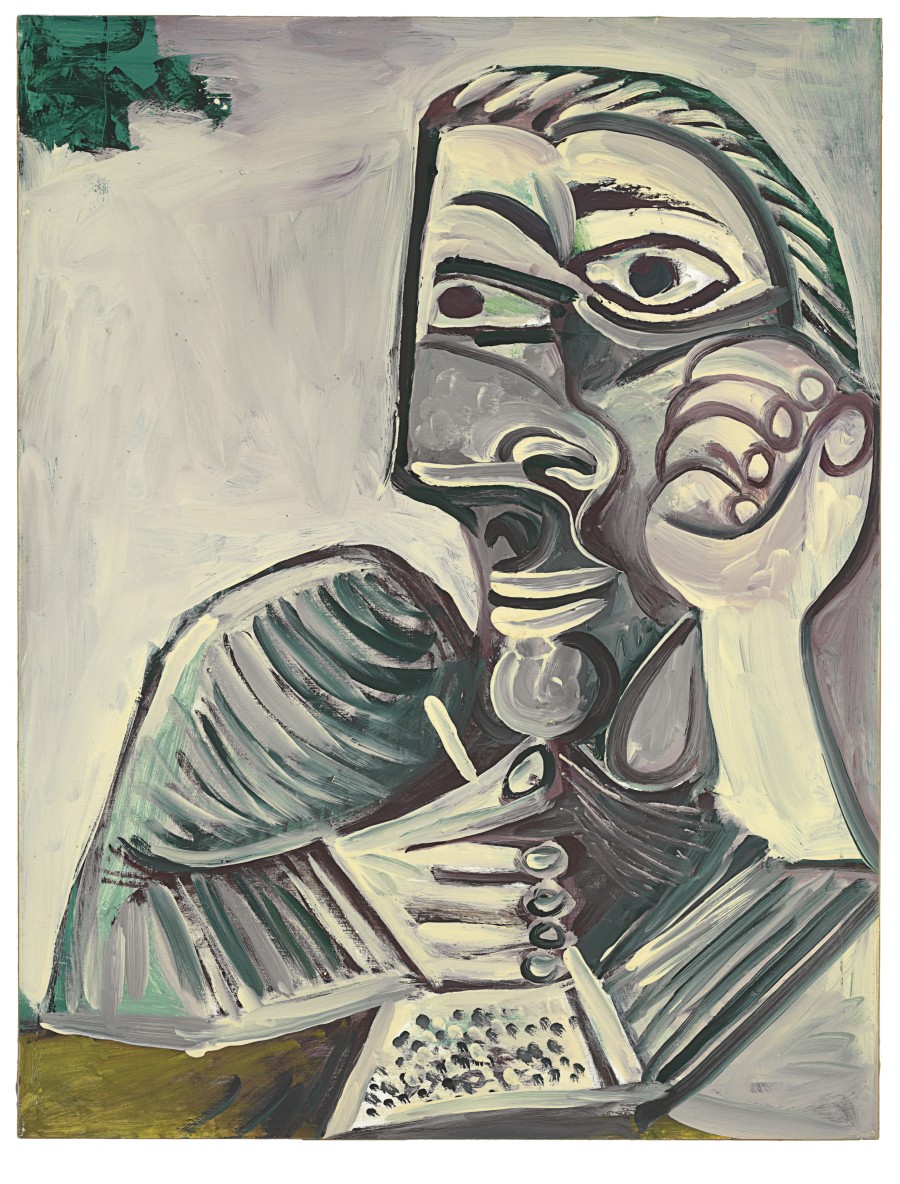
One part of me wonders what it would have been like if Laos were to have purchased the collection intact in its entirety and presented it on display in Vientiane, or the art schools in Luang Prabang or Savannakhet. There would certainly be the question of preserving it from the elements, but that effort, that process alone could be quite interesting, with techniques later employed in other buildings throughout the country.
How would you approach giving Lao art students a meaningful and innovative understanding of Picasso's techniques and methods?
Sunday, June 16, 2013
Considering Lao American Art

Recently, I've been discussing Lao American art, and aesthetics in the 21st century with many of the Lao American artists, particularly in my generation. This includes artists such as Nor Sanavongsay, Mali Kouanchao, Aloun Phoulavan, Sayon Syprasoeuth, Vongduane Manivong, Kinnary Phimpadubsee, and Sompaseuth Chounlamany. I'm always interested in finding others and would love to hear suggestions of others whose work I should be looking at.
Overall, I've seen lots of promising concepts, and occasionally some common pitfalls I would encourage Lao artists to consider as we continue to progress on our individual journeys.
Among some trends I've seen, Lao artists often choose colors that are understated. A good majority prefer to depict emotions that are peaceful, calm, placid. As a result, I recommend that you appreciate it when you see a different emotion, because it's rarely depicted.
We are seeing a lot of static poses more than dynamic scenes in Lao art. Even now, we rarely see extreme or exaggerated motions or physics-defying hyperbole. We have a growing number of portraits emerging that are executed reasonably enough, but I feel we now need to really appreciate any Lao paintings we see with any action in them.
Another area I'd express concern is that Lao painters don't often seem to be doing group scenes well. Beyond three or four figures in a scene is rare. Among most of our artists' bodies of work, well done groups scenes with appropriate and detailed composition are going to be hard to find. You won't often find works with the intricacy of the "Last Supper" or "Sistine Chapel." We do see occasional collage of visual landmarks, such as the mural on National Avenue in Milwaukee, for example.

One question that emerges for me is: Do we see Lao artists struggle because they're not creating art people really want to invite to their house? The trend often seems to be you'll find paintings of musicians, monks, or family members in traditional attire. Occasionally, a landscape painting, particularly those that feature a wat Lao. While these are admirable subjects, we should ask, what can we encourage each other to create that might one day take on the popularity of Eric Enstrom's "Grace" which can be found in so many Minnesotan homes?

I think it's clear the tourist market unfortunately drives a lot of today's Lao art, presenting rustic or the romanticized, reinforcing cliche. We see little that is documentary of the present, let alone imaginative of the future.
We also see contemporary Lao textures tend to prefer smooth lines or soft strokes. There are very few rough or distressed images. I'd consider this problematic when the art gets too cartoony or Bob Ross cheese.
Broadly speaking, we see few urban scenes, and when we do, those tend to be market scenes. Interestingly, despite all of the photographs and videos we may see online of Lao American parties, we don't see that considered a worthwhile subject among Lao American or Lao painters. It almost seems to call for a Lao Toulouse-Lautrec, someone ambitious and daring enough to depict those aspects of Lao American culture others have to date .
This is of course an ongoing discussion. Some immediate thoughts I wonder now are: How might Lao artists make art that creates real conversations reflecting a real set of our contemporary Lao issues, concerns, aspirations? Such as Lao girls reading? Lao B-Boy or video game culture?
As a community there is a direct connection between our success and what we can speak of, and the diversity of how we present that experience. We need work that looks at both the past, present and the future, and we need an art that is bold and risks, one that says no aspect of Lao culture is unworthy of exploring.
But what are your observations and suggestions?
Saturday, June 16, 2012
Considering Lao artist Vong Phaophanit
Savannakhet has produced some of the leading artists of 20th and 21st century Laos, such as NEA Heritage Fellow Bounxou Chanthraphone and Bush Artist Fellow Mali Kouanchao. Vong Phaophanit is another prominent artist who was born in Savannakhet in 1961. Trained in Paris, he currently lives in the UK with his wife and frequent collaborator Claire Oboussier. They maintain their website at: http://www.atopia.org.uk
You can find his work at several acclaimed museums internationally, including the Tate Britain, London; The Irish Museum of Modern Art, Belfast; The British Council Collection, London; and The Arts Council Collection, London. He was on the 1993 short-list for the Turner Prize and held a 1994 DAAD fellowship in Berlin. In 2002 was the award winner of the Art and Work Award for site-specific work with Gensler Architects.
As we continue to build our understanding of the direction of Lao American artists, we should consider the themes he has worked with over the years. Like many Lao artists, memory has been an important theme. Bamboo, rubber, and rice were frequent materials of choice that he has employed as one of several ways to incorporate his heritage into his art. There are many Lao artists whose bodies of work we can examine where they have not always been overt in addressing their heritage. Like many of us, he has shown interest in broader aesthetic and philosophical issues.
There aren't many who do sculpture and installations. A frequent technique of his has been to use familiar materials to expose multiple layers of contradictory meaning. I'd be interested to see how much he has been influenced by the work of figures like Jean Luc-Godard. Often, he has not translated the Lao words incorporated into his works for his audience. This is considered an effort to communicate the challenge of living between cultures.
It's interesting because so many of us, from writers to artists in the Lao expatriate community have been doing such things in our own forms. I wouldn't go so far as to say it's an innate imperative, but I've often found Lao artists do this with a particular frequency.
But what are ways you see Lao artists and writers addressing the themes of memory and the challenge of living between cultures?
You can find his work at several acclaimed museums internationally, including the Tate Britain, London; The Irish Museum of Modern Art, Belfast; The British Council Collection, London; and The Arts Council Collection, London. He was on the 1993 short-list for the Turner Prize and held a 1994 DAAD fellowship in Berlin. In 2002 was the award winner of the Art and Work Award for site-specific work with Gensler Architects.
As we continue to build our understanding of the direction of Lao American artists, we should consider the themes he has worked with over the years. Like many Lao artists, memory has been an important theme. Bamboo, rubber, and rice were frequent materials of choice that he has employed as one of several ways to incorporate his heritage into his art. There are many Lao artists whose bodies of work we can examine where they have not always been overt in addressing their heritage. Like many of us, he has shown interest in broader aesthetic and philosophical issues.
There aren't many who do sculpture and installations. A frequent technique of his has been to use familiar materials to expose multiple layers of contradictory meaning. I'd be interested to see how much he has been influenced by the work of figures like Jean Luc-Godard. Often, he has not translated the Lao words incorporated into his works for his audience. This is considered an effort to communicate the challenge of living between cultures.
It's interesting because so many of us, from writers to artists in the Lao expatriate community have been doing such things in our own forms. I wouldn't go so far as to say it's an innate imperative, but I've often found Lao artists do this with a particular frequency.
But what are ways you see Lao artists and writers addressing the themes of memory and the challenge of living between cultures?
Thursday, November 03, 2011
Little Laos On The Prairie: Sompaseuth Chounlamany

Chanida Phaengdara interviewed Lao American artist Sompaseuth Chounlamany this week at Little Laos on the Prairie. Sompaseuth does some amazing work, and hopefully will continue to share the results of his artistic journey with our community. He's one of the exciting new visions emerging in the community, especially on the East Coast of Lao America. Check it out!
You can see more of his art at http://fineartamerica.com/profiles/sompaseuth-chounlamany.html
Thursday, August 11, 2011
Lao American artist spotlight: Sayon Syprasoeuth

One of the nice things about spending some time out in California this year is discovering new Lao American visual artists. Among the recent ones I've found is Sayon Syprasoeuth in Southern California. You can visit his website and his work at http://www.sayonart.com
He's working in a number of different techniques and I think he has a distinct style and set of themes that he has been working with, that tie nicely back to traditional culture but also more modern sensibilities and experimentation. For Lao American visual art to flourish in the century ahead, this is essential. I look forward to seeing more of his work in the coming decades.
Subscribe to:
Posts (Atom)