Showing posts with label speculative literature. Show all posts

Friday, March 11, 2016

Reality Adjustment, Alien Sex, Black Forests and F.J. Bergmann

F.J. Bergmann wears many hats in the world of poetry. I first became familiar with her work in the mid-2000s, and I read with her for the very first time at CONvergence in Minnesota in July, 2015, where she gave a very lively and assured performance. Over the years, I have come to appreciate her sense of humor, how seriously she approaches her poems as well as those of others, and her commitment to building a sense of literary community. Based in Wisconsin, she enjoys giving talks and presentations on poetry, as well as performing.


An award-winning poet, science-fiction writer, artist, and web designer, she maintains madpoetry.org, a public-service poetry site for Madison, WI. She  is heavily involved with the Science Fiction Poetry Association in multiple roles including the editor of Star*Line, the journal of the SFPA. Additionally, she is the poetry editor of Mobius: The Journal of Social Change.

Her recent accolades include the 2015 Science Fiction Poetry Association's Rhysling Award for the Long Poem, the WFOP 65th Anniversary Poetry Contest, the 2013 SFPA Elgin Chapbook Award, the 2012 Rannu Fund for Speculative Literature Award for Poetry, Heartland Review’s 2011 Joy Bale Boone Poetry Prize, and both the Theme and Poet’s Choice divisions of the 2010 WFOP Triad competition. She has also received an International Publication Prize in the 2010 Atlanta Review contest, won the 2009 Tapestry of Bronze contest, and won the 2008 SFPA Rhysling Award for the Short Poem.

I think there's a lot to learn from her, and thought it would be a good idea to have a conversation with her to get her perspective on literature and the journeys we've been taking. Be sure to visit her websites at http://fibitz.com/ and her journal at http://fibitz.livejournal.com/


Do you mind telling us when you first developed an interest in poetry? How would you describe your access to poetry growing up?

I remember reading some poetry in my single-digit years--my parents had a large anthology of warhorses, a book of Walt Whitman's poems, that sort of thing. Dr. Seuss and the poems in Alice in Wonderland, of course, as well as The Hunting of the Snark. And fairy tales, which I read avidly, often incorporated poems, frequently as incantatory devices, i.e., magical spells. It says a good deal, I think, that when I got married, the person officiating used the Whitman collection from my childhood as a prop.

Have you always been in Wisconsin? How did your family first react to your interest in poetry?

I lived in Paris, France, for two years of my childhood, but grew up in Wisconsin otherwise. I first wrote a poem in eighth grade, and I don't remember ever soliciting any input from my family, none of whom are poets. My husband, Fred, is an excellent first reader, however.

Which poem of yours do you usually recommend to someone who wants to read your work for the first time?

Well, I variegate in style and content a good deal. These two would be somewhat representative of the desired effects: "Grand Tour" and "Suspended Animation" 

Do you prefer coffee or tea?

Black or jasmine tea, with milk, sugar, and, ideally, delectable comestibles in elegant surroundings--and I must refer you to "Tea Ceremony," a poem triggered by being served, after I had requested tea, a styrofoam cup containing lukewarm water, accompanied by a generic teabag, artificial sweetener, artificial creamer, and ersatz lemon flavoring,


If you could have any imaginary being for a pet or companion, what would it be?

Probably a dragon, or any similar rideable flying predator. (I am fond of horses and have spent most of my life working with them professionally, but, as herbivores, they tend to be somewhat timorous.) I am somewhat tempted by the invisible sentient garrote/AI proposed in Zelazny's Amber novels, though.

You've had some exciting successes lately, including the 2015 Rhysling Award for Long Poem. How did “100 Reasons to Have Sex with an Alien” come about? And what might the 101st reason have been?

Well, as the epigraph suggests, 287 More Reasons to Have Sex, by Denise Duhamel and Sandy McIntosh, was the direct inspiration. Duhamel was a speaker at a state poetry conference and read from the (hilariously funny) book, which itself was inspired by an addendum to a research paper on reasons why people have sex. I basically tried to include all the genre tropes and SF cultural-lexicon references I could think of. There are nods to a lot of favorite authors, from Damon Knight to James Tiptree, Jr. As far as the 101st reason ... a Mata Hari-esque seduction in order to steal the secrets of FTL travel, I should think!
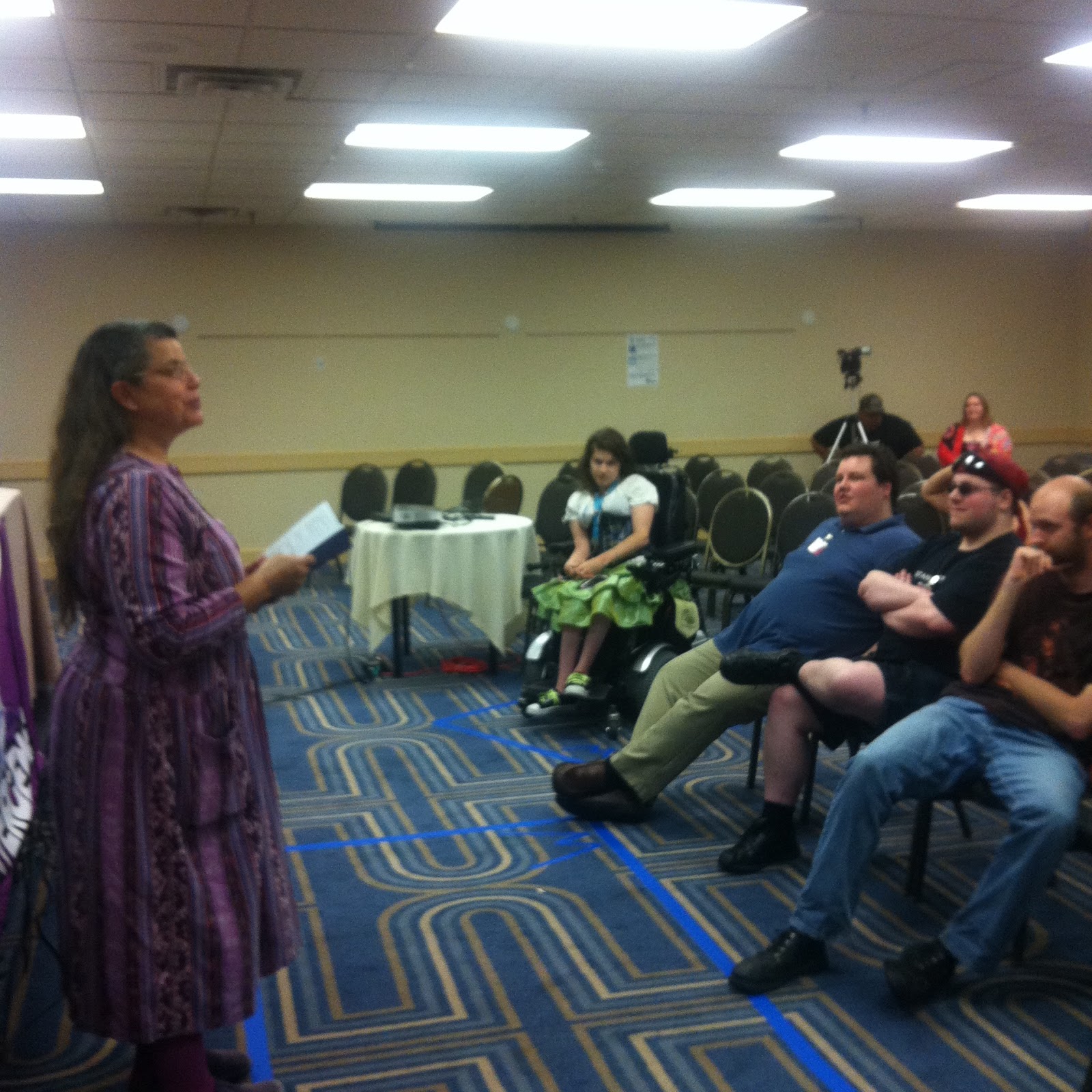

When we see you writing poems like "Anomaly" and "Transference," it's very clear you're comfortable working with either short forms or long forms. What's your process like in determining the style you use for a particular topic?

The poem ends when it has accomplished what it set out to do, which in the case of horror is best accomplished by leaving off the dénouement, and not explaining too much; in "Anomaly," a short series of disquieting images and events resulted in the feeling of an inescapable nightmare--and you know you always wake--or wish you could--at that moment of peak terror. In the case of "Transference," I was using a rather long list of filler words from a spam e-mail (I've used spam as a source for many poems), so of course I couldn't end the poem until I'd used up all the words.


You've done several chapbooks over the last few years, from 2003's "Sauce Robert" to "Out of the Black Forest" in 2012 with illustrations by Kelli Hoppmann. What are some of the important things you've learned about putting a collection of your work together? And will we see a full-length manuscript in the future?

My work is much more variable in style now than it used to be, so it's harder to assemble a cohesive manuscript, especially full-length. I've put together a number of other chapbooks, as well as longer books, but have not had luck finding a press yet (and have been remiss in submitting as much as I should--still trying to generate more spare time).

The poems in Out of the Black Forest were all written in a few months, all based on fairy tales. It had already been accepted for publication, and the publisher had been talking about finding an illustrator, when Kelli said, "I'm thinking of doing a series of fairy-tale paintings: do you have any fairy-tale poems?" I'd previously written a poem for Kelli to illustrate, and have subsequently written a number of ekphrastic poems based on her paintings (see http://the-toast.net/2013/12/13/three-poems-2/ and http://www.dansemacabreonline.com/#!fj-bergmann/c1xd5).

I now have two chapbook manuscripts based on Kelli Hoppmann-painting series, another chapbook of dark first-contact poems, a full-length SF manuscript, several other manuscripts that are more surreal, and am rapidly accumulating a book's worth of horror poems.

Wisconsin seems to be conducive for many poets and the writers of the fantastic and the imaginative. Of course, there's any number of theories and ideas why, but what catches your interest about the Wisconsin speculative arts scene?

Oddly, Wisconsin seems always to have been disproportionately represented in literature, especially when it comes to poetry (as evidenced by this quote: "More poetry is said to come from Wisconsin than any other state in the Union." Badger State Banner, 4/10/1885). I'd noticed, for instance, that the annual Atlanta Review poetry contest has a much higher number of Wisconsin poets as winners and finalists over the years than what one would expect from random distribution ( I've entered it 13 times, been published 3 times, and been a finalist 7 other times). A magician friend has theorized that the effect is due to a gigantic crystal of quartz underlying most of the state, whose visible peak constitutes Rib Mountain.

If you could adjust any part of reality without any ironic or unintenteded consequences, what would you start with?

Not allowing any media posts--online, social, or other--or political speeches without thorough fact-checking. That would totally transform the world!


You see a lot of trends come and go in speculative poetry as the editor of Star*Line, but what are some of the untapped frontiers at the moment, or some lines of poetic inquiry you think we're needlessly leaving by the wayside?

I enjoy riffs on the genre tropes and conventions we've come to know and love, but sometimes there's a dreary sameness about many submissions. There is a fine line between writing poems recognizable as genre and covering new ground; like all editors, I'm hoping to be simultaneously amazed and delighted. Send something no one's done before.

What's your ideal environment for writing? Is it much different from your environment for editing?

I don't care too much where I write or edit. Writing, in fact, seems to go better in noisy bars, or during meetings when I ought to be paying attention. I'm trying to work standing up a lot more, which pretty much limits me to the stand next to my desk. The one thing I don't do is play music. I like music, but my brain shuts down the ears when I'm in work mode.


You're wearing many hats these days, including that of poetry editor for Dark Renaissance Books. What are some of the ground rules you set for yourself as you consider the different types of manuscripts that come your way?

I indulge my own personal tastes, of course! Plus what's appropriate for the specific venue I'm dealing with. In the wake of the Hugo Puppy literary-vs.-genre discussions, I'll say that I feel very strongly that the two are not mutually exclusive. I have eclectic tastes, so I can't say that I'm drawn to any particular style or type of work. Like many editors, what I like isn't necessarily going to be the kind of thing I myself write.

Mobius: The Journal of Social Change is going into its 27th year in 2016. Orginally, it was established as an alternate to the corporate literary scene. As the world becomes increasingly connected, but also increasingly corporate-driven, where do you see the voice and vision of poets most profoundly needed?

I think poets and those who publish poets need to make an effort to place their work before those who aren't poets, who don't read poetry. Many who would remain unmoved by a diatribe or political statement will respond to the same sentiments expressed as a poem. A good poem, that is; I am not a fan of line-broken diatribes masquerading as poetry.


What's a skill that you've found unexpectedly useful on your path as a poet?

I don't think of them as skills; what looks like skill in writing poetry is really a willingness to do the basic background work to develop facility with language-wrangling. Three things, all indispensable:

1) Read. Read lots of stuff. Read classics; read award-winning contemporary work. Read way outside your discipline and tastes. Look up grammar and words you don't know.

2) Write. Spend time writing new work every day. Experiment. Try new prompts and forms constantly. Don't take it so seriously; it's impossible to write well without a sense of humor, aka a sense of the appropriate.

3) Solicit criticism, accept it gracefully and be willing to consider the advice offered. The more experience you have with critiques, whether they are from a crit group or beta readers, the better you'll be able to assess what your work is actually doing.


And finally: As a writer, have you ever had a poem "that got away?"

I have unfinished poems. I have poems that I've later deemed to be unsuccessful. But I pretty much retain control over what I'm doing. I think it's disingenuous for an author to claim that they don't. Writing on a roll, that's different. I've had poems and stories that came out all at once, in a blaze of incandescence. I could use a few more of those!

Tuesday, March 01, 2016

Black Stars, Dead Badgers, Chimeric Machines and Lucy A. Snyder

This week I'm interviewing Lucy A. Snyder, an Ohio-based award-winning writer whose impressive body of work embraces science fiction, fantasy, humor, horror, poetry and nonfiction.

She's received four Bram Stoker Awards, and her body of work currently includes over 150 short stories, 60 poems, and 4 novels. Her writing has appeared in Strange Horizons, Weird Tales, Hellbound Hearts, Doctor Who Short Trips: Destination Prague, Chiaroscuro, GUD, and Lady Churchill's Rosebud Wristlet. You can visit her online at www.lucysnyder.com


At the moment, I'm taking a particular interest in her 2015 collection While The Black Stars Burn from Raw Dog Screaming Press. Her latest contains 13 dark stories, several of which are Lovecraftian or tie in with the King in Yellow mythos. That naturally attracts my attention, as does the Ohio connection. Her poetry collection Chimeric Machines is one I would highly recommend for some intriguing ideas and approaches to speculative poetry.

I was delighted to have her share some of her perspective with me, and I look forward to seeing what comes next for her.

Do you mind telling us when you first developed an interest in writing? How would you describe your access to science fiction and fantasy growing up?

I grew up in a house full of books. My parents read to me every night when I was little -- mostly fairy tales and children's fantasy like the Oz books and Alice in Wonderland -- and taught me to treat books as something special. This more than anything inspired me to become a writer. It was Madeline L'Engle's A Wrinkle In Time that simultaneously hooked me as a lifelong science fiction/fantasy reader and fixed me on the idea of writing fantasy and SF instead of mainstream work. I remember that the book spoke to me in a way that nothing I'd read until then really had, and I had that shivery sense of wonder you get with really good speculative fiction. And I thought to myself that if I could write something that made another person feel the way I was feeling, then that would have to be the best job in the world.


We often hear about how writers get started, but what keeps you going these days, as a writer?

I love books ... and I especially love getting books in the mail that have my name on them! That's the simple answer: author copies. The more complicated answer is that writing is the one thing I've really dedicated myself to professionally. Consequently, I've set all sorts of short- and long-term goals for myself, and seeing myself gradually achieving those goals keeps me pressing on to the next goal. The occasional bit of fan email doesn't hurt, either!

Which story of yours do you usually recommend to someone who wants to read your work for the first time?

It would have to be either "Magdala Amygdala", which won the Bram Stoker Award and which has been my most frequently-anthologized story, or "Installing Linux on a Dead Badger", which became a minor Internet meme. And which story I recommended would depend on the tastes of the reader, I expect. Most horror readers agree that "Magdala Amygdala" is my best piece of short fiction so far, but "Installing Linux on a Dead Badger" is funny (in all senses of the word) and readers have told me that the humor in it really connected with them.


Do you prefer coffee or tea?

I drink both. I'll drink several cups of green tea during the course of a day, but I absolutely have to start the day with a glass of iced coffee with milk. I'll be happy to drink hot coffee, but I like cold coffee just as much.

What inspired While the Black Stars Burn? What was your writing process like for this one?

It's a collection, and so in a general sense, my writing process wasn't any different than it was for Soft Apocalypses or any of my other collections. And the process in general is write stories, generally for anthologies or magazines; I try to sell most of my individual stories at least once before I put them in a collection, simply because I earn more money from my writing that way, but I also do try to include one or two new pieces in a book. Once I have a critical mass of stories I haven't collected, I go through them to see if and how they fit together. I spend a fair bit of time looking at how the stories flow and resonate with each other when I'm putting a collection together. I've gotten better at that as I've gotten more experience.

I've been productive enough that I've been able to release two story collections two years running, and both of them have contained fairly recent stories. I wrote most of the stories in While the Black Stars Burn in the past couple of years. I've been getting a lot of invitations to write for Lovecraftian and King in Yellow themed anthologies, and the contents of the book strongly reflect that. I've also been reading Robert Chambers (the author of The King in Yellow) and Lovecraft for my MFA work and have been thinking about those two authors quite a lot, and so I've been intentionally working with various themes from their fiction.

For instance, I wrote the title story, "While the Black Stars Burn," after I was invited to submit a story for the Cassilda's Song anthology. I knew I wanted to write a story evocative of the Chambers story "In the Court of the Dragon" and also evocative of Lovecraft's story "The Music of Erich Zann" but which was not a copycat pastiche of either one. I ended up writing the story at my first winter residency at Goddard College, and the heat wasn't working well in my dorm room, and my being profoundly cold definitely influenced the story as well. In addition to being physically uncomfortable, I was wildly underslept and fighting a bit of writer's block. I remember I ended up watching the "Turn Down For What" video on YouTube about 20 times in a row before I wrote the bulk of the story. Why did I watch the DJ Snake video so obsessively, and how did it affect the story? No clue. My brain is a strange place.


You also write humor, such as "Installing Linux On A Dead Badger." Have you found you process very different between these genres?

I do try to include humor in my fiction as leavening against the horror, but yes, my process for writing specifically humor stories is rather different. Instead of imagining a character with a problem, I usually start with a ridiculous concept, treat it seriously, but then spin it out to even more ridiculous extremes. For instance, how would you install linux on a dead badger, and why? And what kind of world would you have in which that was a desirable installation? Characters in that case become supporting players to the situation and concept, and my focus is on layering in different kinds of humor.

Your experiences include time in South Carolina, Texas, and now Ohio. What's been the great commonality between these spaces, and what are some of the biggest differences you've found?

At this stage, people move around so much that I think the regions have much more in common than they used to (if indeed those huge differences ever really existed). People are people, for good and for ill. I'm good friends with people who grew up in environments I was led to believe were so different than my own that we could never possibly have anything in common. But we do: movies, books, music ... all the cultural elements that transcend regions and countries. Last summer, I was a guest at AnimeKon, a pop culture convention in Barbados, and the people there were geeking out over all the same movies and shows and comics that they geek about at conventions here in Ohio.

Despite chain restaurants taking over the American landscape, I'd say the food is the biggest difference between South Carolina, Texas, and Ohio. I didn't know what most good Italian or Polish food was like until I moved North. And despite the blossoming of Mexican cuisine in Columbus, I have yet to find a place here that serves a decent tamale. Of course, my definition of a decent tamale is based on what I ate in San Angelo when I was growing up, and I'm sure that anyone from Mexico City would look at the tamales in the restaurants there and say "What? This is not a real tamale ...."


You took on some fascinating subjects in your poetry collection Chimeric Machines. How long did it take to complete this collection, and which poem do you feel you worked the most on?

I wrote the poems in that collection over the course of about 10 years. The one I worked on the most intensively was probably "Flyboy"; it's a narrative sestina, which is a challenging form.


Do you feel there's been a significant difference between your mindset for poetry and your mindset for short stories?

Yes, very much so, although there can be a lot of overlap in writing poetry and in writing micro-fiction in terms of needing to be mindful of the weight and effect of every word. Writing poetry opens up parts of my mind that writing fiction does not. You have to focus on layering in meaning, on how your line breaks affect those meanings, and on how the words look and sound together within the poem. The story in a narrative poem is often the least interesting thing about it, though of course that surface story is what a lot of causal poetry readers are primarily experiencing when they read a poem. It's a challenge to write a compact, vivid poem that explodes with layered meanings, but I find it very satisfying.

Tuesday, February 23, 2016

Cajun Sushi Hamsters, Murder, Aliens and Cats. An interview with Mary Turzillo

Mary Turzillo is a writer of many talents with a great sense of humor, imagination and poetry that I admire. I first ran into her work as a member of the Science Fiction Poetry Association, and quickly realized we had many things in common as writers with roots in the Midwest.

Based in Ohio, her work includes the award-winning Lovers & Killers, which won the the very first Elgin Award for Book of the Year from the Science Fiction Poetry Association. She also received a Nebula Award for her novelette Mars is No Place for Children. Her short fiction has been appearing since at least 1994, and she's produced three poetry collections so far beginning with her 2007 debut Your Cat & Other Space Aliens.

Mary has been a professor at Kent State University, and written books on Anne McCaffrey and Philip Jose Farmer. Her husband is the science fiction writer and scientist Geoffrey Landis, who I also feel does wonderful and thoughtful work well worth reading. In Cleveland, she founded the Cajun Sushi Hamsters writing workshop.

I was very curious to see her perspective as a writer and poet, and I appreciate her taking the time out to discuss this ideas with me. Be sure to visit her website and check out her writing.There's much to learn from her style and technique, and I'm looking forward to seeing her next collections.


How did you first develop an interest in poetry? How would you describe your access to poetry growing up?

I was read to from a very early age (two or three) by my grandmother, grandfather, and mother. According to my grandmother, I swatted my grandfather because he didn't use enough emotion in his reading. A lot of books for very young children are in verse, as you realize.

Once I got into first grade, I conceptualized that words on paper were connected to spoken words and stories, and I resolved to write my own Things (I didn't see any difference between poems and stories, and I still don't, really). My mother happens to have saved my first poem, which I wrote down in second grade.

She bought me complete works of Edgar Allan Poe, which of course set the course of my imagination for the ensuing years.


Which poem of yours do you usually recommend to someone who wants to read your work for the first time?

Oh, how to choose? Let me recommend three, since poems are short. "The Emperor's New Spacesuit," "If You Loved Me" (my elegy to borderline personality disorder), and "The Hunter's Mothers." These are in Your Cat & Other Space Aliens, (VanZeno).

The book I'm proudest of is Lovers & Killers, from Dark Regions Press which won the Elgin award in 2013.

I also have a recently published Best of chapbook called A Guide to Endangered Monsters, from Night Ballet Press. It has all my favorites and prizewinners.

Do you prefer coffee or tea?

I like both, but lean a bit more to tea. My preferences change all the time, but right now I like Tulsi Red Chai Masala. And of course, like all cultured people, I love Earl Grey.

If you could have any legendary being for a pet or a companion, what would you choose?

Ganesha, because he is the the remover of obstacles, patron of arts and sciences, god of intellect and learning, Lord of beginnings, and the writer's best friend. And who wouldn't love a deity in the shape of an elephant? But maybe that's a bit blasphemous, because Ganesha is, after all, a god. So my second choice would be Gummitch, from Fritz Leiber's "Space-Time for Springers."


What aspects of life in Ohio did you find most conducive to writing? Did you feel there any distinctive challenges?

Cleveland is a real hub for writing of all kinds. My husband runs a blog called clevelandpoetics (http://www.clevelandpoetics.blogspot.com). The clevelandpoets calendar shows at least one poetry event every night, sometimes several. We have at least ten local indy presses, and I'm not even counting college and university presses. Northeast Ohio is the happening place for poetry. I spent time in Cambridge, Massachusetts, and in Pasadena, and it was hard to find much going on. Workshops, if there were any, were run by university prigs who wanted to charge huge fees, and who in my humble opinion needed a few lessons themselves, in humility if nothing else. As to readings in Pasadena and Boston? Oh, maybe a few here and there. A couple a month. Never open mic. But in contrast, Cleveland, Youngstown, and Akron have some wow stuff going on. Cleveland's slam team is prominent in the nation.

As far as fiction is concerned, in the internet age, geography is not a big issue. You read, you submit electronically, no problems.

Superman was born here. Roger Zelazny (who was a poet in addition to being a fiction writer). Vachel Lindsay. Hart Crane. Rita Dove. Paul Laurence Dunbar. Langston Hughes. James Wright. Ambrose Bierce. Gloria Steinem. Joe Eszterhas. Leigh Brackett. Harlan Ellison. Kenneth Patchen. John Scalzi lives here now. The list goes on.

Sometimes Geoff and I think the cornucopia of poetry opportunities is a lure that keeps us from writing fiction.


When did you feel Your Cat & Other Space Aliens was "finished" and ready to send to publishers for consideration?

Actually, it didn't happen that way. I do a lot of readings, mostly local in northeast Ohio, but also at cons, both in the US and the UK. A local poet and editor, Marcus Bales, had heard me read and had also read my stuff. He was inaugerating a press devoted to spoken word poetry, and he asked me to submit a group of poems. I gave him 96 poems, about half of which were already published, and he chose 69 of these to be in the book. In some ways, Marcus was a collaborator, in that he selected poems that he thought were the best and that worked together thematically. He didn't edit the poems themselves, but he definitely worked with me on concept. We came up with the title together and it really works for me.

I've never actually published a poetry collection that I submitted cold. I do have a couple of books I've lazily shopped around for various contests and publishers. I don't like fee contests; I am concerned that younger, less well-heeled authors are shut out of that process. Not everybody can shell out $50.00 every time they see a new call for a manuscript. I have five single-author collections in print, and all of them have been published because the editor came to me. I admit it, I'm lazy.

Anyway, Marcus published Your Cat & Other Space Aliens under his imprint of VanZeno, and I'm really happy with how it came out. He's a brilliant editor and incidentally a very fine satiric poet.

Marge Simon and I have four collaborative collections, and she placed them, being not only a genius poet but a woman who knows the indy poetry landscape better than anybody else in the known universe. She was a long-time president of the Small Press Writers and Artists Organization. We mull over where to submit (we have been rejected a few times, mostly because our concepts were pure hubris). And we mull over whether each book is finished. In fact, we're mulling that over right now with a book called Satan's Spawn.

I should mention that the brilliant and underappreciated poet Bruce Boston has edited two of my collections and also the collaborations Marge and I did. Bruce came up with the title of Lovers & KIllers, and he also did the cover. I couldn't be happier.


What's been one of the most unusual subjects you've tried to take on with a poem?

Jodi Arias. Marge and I are writing a collection of poems about murderesses. Jodi stands out as one of the strangest subjects for poetry that I can think of.

What's one of your enduring memories from the Cajun Sushi Hamsters?

Steve Swiniarski (A.K.A. S. Andrew Swann) brought the early manuscript of Forests of the Night to our workshop, and we gave him enthusiastic encouragement. We have a custom that a writer has to bring a bottle of champagne to the workshop when he or she sells a story. When Steve sold Forests, and was reminded of this, he confessed shamefacedly, "I'm not old enough to buy champagne."

How easy is it for you to determine if a piece should be prose or poetry? What was the most difficult example to choose from, so far?

Basically, the issue is whether I want to spend an afternoon first-drafting a poem, a couple of weeks making it into a story, or a year making it into a novel. If I can stab the subject quick and deadly, it's a poem. I have a poem I've never published about a certain genetic aberration, and I've written a novelette on the same theme. They go together. I've never sent the poem out, because it would be a spoiler for the novelette. I really should get that novelette in the mail --

Of course fiction needs more of everything. My poetry tends to be narrative, but a story or a novel needs a lot of threads and characters and incidents.

I say I can write a poem in an afternoon, but I've picked at poems, adding a word, removing a word, twisting a line, for years. You know how it is, right? You lie in bed trying to think of the exact right word.

Are there any frontiers in poetry that you feel today's poets could explore more?

Right now SFnal writers are dodging the whole form issue. We need to write form poetry, not just doggeral, but actual good villanelles, sonnets, tanka, sestinas, etc. I personally write a lot of non-form poetry, and I don't think it's in any way inferior to the hard stuff, but I think poets should experiment with form just to see how it feels. I think what a person learns from writing metered poetry or poetry that has some exterior shaping transfers to free verse.

I also think many speculative poets should browse in the vast ocean of poetry that's being published and performed today. There's so much. So much variety.

One good thing is that there seems to be no wall between speculative poetry and the poetry of the greater literary world. A lot of Billy Collins' work could appear in Asimov's. I sometimes meet poets who have no idea that their work is speculative and then a couple months later, at my suggestion, they submit to Star*Line and get an acceptance.

Friday, February 12, 2016

[Poem] Narrative of the Naga's Heirs at Uncanny Magazine


My new poem "Narrative of the Naga's Heirs" in Uncanny Magazine debuted in Uncanny Magazine this January, and it is now available online as free content. Be sure to check it out, and as always, thank you for supporting diverse voices in poetry and speculative literature! Quick Sip Reviews also did a nice review of my poem and the other works in this issue of Uncanny Magazine which really added to the larger discussions we've been having on speculative literature lately. Be sure to check it out.


Wednesday, November 25, 2015

The Big Easy, Big Ideas, and Brandon Black


For some time now, I've had the pleasure of knowing Brandon Black, a New Orleans-based writer of fantasy and science fiction. He has the particular distinction of being the editor of New Orleans' first locally-written and produced steampunk and gaslamp fantasy anthology, New Orleans By Gaslight. 

He has a terrific sense of story that's inclusive and expansive, and his posts on other areas of genre always give me something to think about. He's one of the nicest guys I know, and I see many similarities between our experiences and influences growing up. I had the chance to interview him this month in the middle of his busy schedule of writing and making it all work out down in the bayou.

Be sure to visit his website at: http://brandonblackonline.com!

How did you get inspired to take up writing? Who are some of the writers who are enduring influences upon you?

My life has been woven through with stories. I learned to read from comic books. When we'd go over to my grandparents' house, I'd pull out this huge cardboard box of Golden Age comic books under my uncle's bed and just read for hours. I've never understood why they push such dry material on kids in school. Comic books got me to the point where I could read by the time I reached kindergarten and so they kicked me up into the first grade and even when I got there, I took reading class with the second graders. The Legion of Superheroes, the Avengers, the Green Lantern Corps and the Justice League are only a million times more interesting than "See Jane run."

My father was a physicist and he's the one who introduced me to science fiction (when I was a boy, he gave me an inflated astronaut instead of a teddy bear.) When I was old enough to understand it, we'd watch Doctor Who together on PBS. That's still one of my fondest memories of my father. But I'd have to say anime was the biggest early influence on me other than comic books. I remember the epic story of Space Battleship Yamato (Star Blazers here in the States), a crew of desperate young people making a trip of a hundred and eighty thousand light years, out to the Magellanic Cloud and back, in just one Earth year, with the goal of saving all life on Earth. That's a story!

I still remember that awesome moment in Robotech when I heard the narrator say, "Meanwhile, twenty light years away..." A transition. A simple transition between scenes and I was awestruck. This was a story of such scale, such scope that meaningful events were occuring simultaneously twenty light years distant from each other. I think that's when I started wondering if I myself could write science fiction.

As for authors whose work I revere, let's see: Larry Niven, Jack Vance, John M. Ford, Scott Cunningham, Louie Martinie, J. R. R. Tolkien, Grant Morrison, Alan Moore, Douglas Adams, G. R. R. Martin, and Neil Gaiman.

What’s your next big project you want to take on as a writer?

I want to write a huge sprawling epic of a novel. I want to write one of those three hundred and sixty thousand word books that panting for breath you can report to the police that you managed to bludgeon your attacker to death with because you had no other weapon with which to defend yourself.

I want to write a Great and Mighty Book worthy of Douglas Adams' line "and with a million sleek and horribly beweaponed star cruisers poised to unleash electric death at his single word of command..." Yes! That's the sort of book I want to write! But I'm not ready. I'm not ready as a writer and I'm not at the point where I would need to be in my career. I can't imagine there's a publisher anywhere that would take a three hundred thousand word novel from a new author. They'd insist on cutting it into three books and making a trilogy of out it and that would really just kill my enthusiasm for it. I want to write an epic work, an integral work that reads as a single novel from beginning to end, despite its length.

And there's that other annoying minor point that I haven't finished a novel yet at all. I have a steampunk novel that I'm writing and I need to finish it. Once it's done, then I can start looking to writing something longer.


New Orleans has a strong literary tradition. In what ways do you feel that’s impacted your approach to writing?

Rather than sound bitter, I'll just say that while New Orleans does have a very strong literary tradition and there are many people of letters who are passionate about writing and literature here, that doesn't mean they are passionate about science fiction and fantasy. I received little to no support or encouragement from my instructors or most of my fellow students in creative writing classes, save for Dr. Blackwood at LSU. The rest of my instructors at various points actively tried to dissuade me from writing science fiction. One of them, a full professor and at one point head of his college's creative writing department said that he didn't understand science fiction so he didn't allow his students to write it.

Can you imagine ANY other genre where an instructor, a full professor, could get away with saying something like that? "I've never really understood Westerns, so I don't allow anyone in my classes to write them." They would have laughed him off campus! In his defense, and I never thought I would say those words, I wound up creating the New Orleans Science Fiction and Fantasy Writers' Circle for much the same reason. I had participated, eagerly and productively, in a writers' circle at East Bank Jefferson Library but had begun to notice as my work progressed that increasingly comments from the rest of the circle had begun to taper off. Whereas I had before received useful criticism about this or that story and where it needed to be changed, particularly as I began to settle on steampunk as my genre of choice, criticism devolved into "good story as always." And while that's appreciated, it's not useful.

As for New Orleans' fandom, the difference between them and the ivory tower has been like night and day. Fandom's been incredibly supportive of my work going all the way back to when I wrote Star Trek fanfic for the Krewe of the Enterprise newsletter. I've given panels on steampunk at Mobicon in Mobile, CoastCon in Biloxi and I've been a regular guest at CONtraflow here in New Orleans for the past several years. Fandom's been very good to me and I appreciate it.

Fandom here is why I dream of making New Orleans a great literary mecca for science fiction. Starting the Writers' Circle and the By Gaslight anthology series are just the opening moves. What I'd like to see here one day is a thriving science fiction and fantasy literary society giving out its own yearly awards, a quarterly journal of fantasy and science fiction based out of New Orleans and a yearly "Best Of" of New Orleans' science fiction and fantasy. I want to give back to local fandom all it's given me.


Being a writer is a tough process, and this year has been a little more rough for you than most. Can you tell us a little about what’s happening? 

After Katrina, I evacuated to Hendersonville, North Carolina and then to Decatur, Georgia and finally to Mobile, Alabama. I lost my job in Mobile and moved back to New Orleans. My job search was pretty abysmal and so I hit upon the idea of making a go as a professional writer. I hadn't written much of anything in years and I had pretty much given up on the dream of being a full-time author. But I wasn't finding much in the way in the local job market, so I decided to buckle down and do some writing. And I achieved some great early successes. I had a story story published in Dark Oak Press' Dreams of Steam III and another in Seventh Star Press' A Chimerical World: Tales of the Seelie Court. I pitched the idea for New Orleans By Gaslight on my Facebook account and it's like the project slipped from my fingers and started rolling downhill from there. I was just entertaining the notion of doing an anthology and people were responding with "I've already started my story!"

New Orleans By Gaslight wound up being a big success, with the Times-Picayune running an article on the book and the East Bank Jefferson Parish Library throwing us a book release party. Things were looking good. But then, my health worsened and my car died. I should have put the brakes on trying to further my writing career and started looking for more conventional employment then. But I'd had this idea for a non-fiction book, something I'd been working on and off on since before Hurricane Katrina. I still had some savings and I was very confident about how my career was going and the profits that could be made from a nonfiction book. My researches had indicated that the industry standard was to pay an author an advance up front after accepting the book proposal and then work with the author to finish the book.

I was wrong. Very, very wrong. Publisher after publisher loved my book proposal. That too helped dig me deeper. Even when publishers declined to accept the project, they praised my writing and told me my book proposal was the best they'd ever read and it was only a matter of time before some company picked up the project. But no one did. At least, no one offering an advance. Months had gone by and the money I was counting on never came. Three publishers in the end contacted me interested in the book but none of them offered a cash advance and by that time, my financial need was pretty desperate. I couldn't even get an agent to intercede on my behalf. All my research had said that the easy, instant way to get an agent was to do everything yourself -- come up with an idea, write the sample chapters, identify publishers who printed material similar to what you were pitching, put together a book proposal and send it out to said publishers, all in the hopes of being able to say to an agent: "Look, I've got a publisher who's sent me a contract for my book, I just need someone to negotiate for me."

What I discovered was that if the publishers didn't mention a specific amount of money as an advance, that no agent was willing to take the gig. Their assumption was if they didn't offer X amount of money up front, the Y amount the agent might be able to convince them to part with wasn't enough for the agent to get out of bed for.

In the end, I was grateful to have an agent spell that out for me as too many other agents just said, "Great project but I don't think I'd be a good fit for it." I can't communicate the anger and frustration I felt, that I still feel, desperately needing money, having to turn to friends and family for my rent, for money for food and medicine, terrified of being homeless and all the while, sitting on a project that publishers and agents have said time and time again would be a lucrative success, is of great literary quality and worthy of publication, only to turn around and then say, "I don't feel like a good fit for it."


What are some of the great frontiers you feel more writers need to address in the coming years ahead?

Transhumanism is, as I see it, a great wall looming in science fiction's future. We're already living in the age of cyberpunk. We are fast approaching a time when people will be able to interface their brains directly with computers. I feel, at that point, that those people won't have much of anything in common with those of us who haven't experienced that and that that wall was and is a barrier to my literary interest. I can't imagine what it would be like to be a human being who could mentally slow time to microseconds and in that time, access the world's informational stockpile in order to make a decision.

What will a simple argument between boyfriend and girlfriend sound like when they both have computers in their heads downloading the internet? What will people care about, socially, politically, economically? When bickering about politics on Facebook is replaced with the instantaneous ability to fact check statements and download whole arguments, histories and philosophies in an instant, what will laws and human interaction even look like? What will entertainment look like? What will people care about?

Transhumanism offers to elevate humanity to godhood. And I suppose I'm too humble to want to write stories about real gods. When I do read and write about deities in fiction, it's humanized deities with goals and objectives and wants and desires that we as human beings have, not remote, incomprehensible abstract entities that have nothing in common with us because they've existed in some rarefied domain for millenia. When people move from being people to "being as advanced to us as we are to an amoeba" as Spock would say, how can we write about them? Why would you want to?

Bob argues with Rick about nth level transcendental hyper-dimensional tachyonic wave mechanics and how those wave dynamics replicate recurring patterns in hyper-time economics. Both Bob and Rick present computer simulations and studies based off those simulations -- that they've just now run in their heads -- to support their respective sides of the argument. I can't follow the argument. I can't follow their emotions. I can't follow their thought processes. An argument, a scene, that might change their lives forever might happen in the time I could blink. This crucible moment that led the two men to walk in different directions and work to change their society forever happened while I burped and tried to remember what I had for lunch. I don't know how to get past that wall.

What’s your advice for younger writers who are just getting started?

My advice to writers just getting started: Don't major in English. Don't pursue a creative writing degree. You can always take creative writing and literature classes as electives for another major. If you want to write science fiction, major in physics or engineering or computer science. You want a college degree that will help you put food on the table. You want a degree that will give you time and a comfortable lifestyle in order to write.

I majored in Military and Political Journalism and then got a Masters of Fine Arts in Creative Writing. I have only once in twenty years gotten a job specifically because of those degrees. All they've ever done for me otherwise was let me check the box next to "do you have a college degree?" on an application. By comparison, I knew a guy who got a four year computer programming degree and from the day he stepped off the college stage had a six-figure job, in his early twenties. That's more money in a single year than my parents made together any year of their lives. I knew another who worked in computers and made so much money that he only worked every other year to finance his bachelor's lifestyle.

My advice to you is to find a degree program that you'll be happy with that'll get you six figures and take creative writing classes on the side. Trust me. You'll be so much better off.

Monday, November 23, 2015

Two poems to appear in Uncanny Magazine in 2016

I was delighted today to receive news that two of my newest poems were accepted for Uncanny Magazine in 2016. In the meantime, be sure to check out their latest issue, which has some wonderful work in it, including new poems by Mari Ness, Sonya Taaffe, and Lisa M. Bradley!

For those of you who are curious, yes, these poems fall firmly in my ongoing Laomagination series. They'll involve some very familiar figures if you've been following my work since DEMONSTRA, but I'd like to think it's also not essential for you to be that familiar with Lao American and Asian mythology and folklore.

The rest will just have to be a surprise until it's published!

Tuesday, July 07, 2015

[Poem] "Slices of Super Science" debuts in Uncanny Magazine


I'm delighted to report that my poem "Slices of Failiure in Super Science" debuted today at Uncanny Magazine, along with the work of great writers such as Shveta Thakrar, C.S.E. Cooney, Sofia Samatar, and E. Lily Yu.

Be sure to check the entire issue out!

The featured fiction of this issue includes "Woman at Exhibition" by E. Lily Yu, and Mary Robinette Kowal's "Midnight Hour." I'm quickly becoming a big fan of Shveta Thakrar's work, and "The Rainbow Flame" is a great example of her style.

The other poems in this issue are "The Saga of Captain Jens" by C. S. E. Cooney and "Σειρήνοιϊν" by Sonya Taaffe. "The Saga of Captain Jens" is a fun, rousing tale of a fantastic pirate queen dedicated to Chicago-based writer, educator and editor Tina Jens.

Sofia Samatar presents a nice quick snapshot on the subject of "writing queerly" in SFF literature looking at three approaches and what we might consider about these techniques. She cites the work of An Owomoyela, Samuel Delaney and Ellen Kushner in this issue, and her points are well worth considering.

It's been great to see Lynne M. Thomas and Michael Damien Thomas keep this wonderful magazine going. Their selections have been thought-provoking and intriguing, and I look forward to seeing more from them in the future. I'm glad they're creating a space where diverse voices can really find an audience and we can see some impressive ideas emerge to inspire and excite everyone.

As a poem, "Slices of Failure in Super Science" came up in the aftermath of discussions regarding the classic horror films of the mid-20th century that were so often on the airwaves when I was growing up as a child in Michigan. There were often discussions of films such as "They Saved Hitler's Brain," "The Man With Two Heads," "Blackenstein" and "The Brain That Wouldn't Die" which gave us the classic imagery of "Jan in the Pan." In the 1980s, I often found myself watching films like "Re-Animator" and "From Beyond," "The Lawnmower Man" or "Flatliners" which had themes of the search for immortality and the defeat of death at their heart.

In this poem, I wanted to take a look at the different forms of failure that take place along this quest. I sought to probe our interest in preserving our consciousness, and how the West really tries anything it can to avert a final reckoning.


A frequent point I'd been making throughout CONvergence this year and other conversations is that of course, these ideas are largely centered in a very Western conception of the cosmos, and I don't think we've really seen a full exploration of these ideas in Lao and Southeast Asian literature.

This should actually provide many of our writers a lot to work with. What might happen in such stories. When our world-view is largely informed by a sense of reincarnation and multiple lifetimes, for example, how does this adjust the way we try to upload your consciousness. Might uploading or preserving our consciousness have a karmic weight or repercussion? In the Therevada approach, would it be a violation of the five precepts or another element of the Buddhist perspective to seek or to assist efforts in immortality?

If you're successful, does your consciousness continue to accumulate karmic merit and stains? Or do you get a reset? And if you do, then, are you really the same person? If not, then what's the point? Or is it possible, that you also have a new set of karmic laws and constraints applied to you? A Buddhist iteration of the Laws of Robotics. What does the precept against immoral sex mean to a cyber-consciousness? Could that be broadly interpreted as unethical distribution and reproduction of your organizing algorithms or something, or merely abuse of teledildonics?

But of course, "Slices of Failure in Super Science" is a poem, and in this case I didn't want to probe the question exhaustively, but to open the matter up to some further inquiry. Share and Enjoy! ;)

Wednesday, March 26, 2014

Profiled at the Poetry Foundation

Photo by Boon Vong

As a nice milestone today, I just became the very first Lao American poet to be featured on the Poetry Foundation website. It has been a long journey. One might argue well over 40 years of Lao in America. But the journey has let us learn many things, meet many people. As I noted elsewhere, I may not always be able to talk you about everyday life. But we can almost always talk of the world and art, and that is a grand point to meet.

Another point of interest connected to this: In Chicago, is the Poetry Foundation is exhibiting the handwritten versions of the poems from the Poetry Parnassus of the 2012 Olympics. There, you can see my handmade version of my poem "On A Stairway in Luang Prabang" that was part of the Olympics.


I hope my fellow Lao Americans see this not just as a personal victory, but a community victory, and that we recognize the value of our words and the things we can change from sharing our voices. That comes with responsibilities, but also infinite potential worth fighting for.

I have also now been included on their list of Asian American poets the Poetry Foundation presented earlier this month. In another post, I mentioned a number of Lao American poets who could also be included as significant and emerging voices in Lao American and world arts and letters. No one list will be completely comprehensive or complete, but it's impractical not to make an effort to start somewhere.

I have seen critiques that Asian American poetry can not be distilled into a list or manageable categories,  but I far more fear an environment where we do not make an effort to recognize individual and distinctive voices in our community.


For over six centuries, Lao culture has enjoyed a profound journey of over 160 ethnicities within our borders. Plurality and diversity and an amicable approach to life have been great hallmarks of our culture. The Lao have almost always held deep contempt for monolithic voices and uniformity. This has its disadvantages at times, but for every generation, learning to navigate that has been a journey that strengthens us rather than diminishing us. I would deeply hate to see that change.

Within the US, I particularly believe we are obliged to create and express ourselves to the limits of our imagination.


Five years ago, when I became the first Lao American to hold a fellowship in literature from the NEA, I wrote "I recognize those who gave so much around the world to bring us to this point. Some names we know, so many we do not. I thank those voices, those souls, and add my own to our collective story of freedom and dreamers. And to those who come upon these words of mine: Write. Create. Add your voice to this magnificent tale."

Those words still hold true.

Thank you all for your wonderful support over the years, and I hope we see this moment not as an end but another step in a journey that began long before us, one that will continue long after us.

Sunday, February 23, 2014

CNN Travel: Black magic traditions of Thailand

A few years back, CNN did a quick overview of superstitions and beliefs regarding the supernatural in Thailand. While far from comprehensive, it may provide a good introduction for many who are just starting to understand the culture and who are looking for interesting ideas for horror stories set in the region.

Sunday, February 16, 2014

[Poem] The Dream Highway of Ms. Mannivongsa, Part IV


IV.

Zombie Kabuki in Seattle.
It’s all the rage.

They love their coffee in this city,
But she recalls the snakes and bombies,
And dilapidated dinosaur museums of old Savannakhet
Whenever she idles through.

“How many battles did it take to write The Art of War?”
She debates with the foxy lady
Who’s secretly a black magic woman born to bewilder
Like a bard’s imperfect actor upon the stage
Or a stone-faced troll beneath a bridge
No gruff goat has ever known.

The world has its Wendigo, Shoggoths and Jabberwocky,
But winged Kinnaly remain aliens to a galaxy 
Hammering a new apocalypse
For beautiful children who will grow up strangers
To the inked page,
To bricks, to mortar, to boundaries.

If she had kept the first camera obscura of Mozi,
Ms. Mannivongsa might have changed the cosmos,
But what is an attachment to memories
Or all of these shiny electric brains?

She prefers the dance of the mermaid and the monkey
Free from modernity.


Wednesday, February 12, 2014

She Walks in Shadows: All-woman anthology inspired by H.P. Lovecraft

I had the distinct honor of being the first person to donate this exceptional crowdfunding campaign for an all-new anthology of stories inspired by H.P. Lovecraft, She Walks In Shadows This anthology will be produced by Innsmouth Free Press, maker of bizarre books, (including my latest book DEMONSTRA) and delivered in the fall of 2015.

As the editors explain: "Do girls just not like to play with squids? That's the question an editor asked on Facebook. What followed was a long discussion on Lovecraftian fiction and women. And the need for an answer. 

 The answer: Women do write Lovecraftian fiction. We aim to prove it with your support. More than a dozen female authors have gathered to write original Lovecraftiana and place it in a single volume under the title She Walks In Shadows."

Already, they've secured some amazing women writers for the project who will be writing stories based on various women established within the Cthulhu Mythos of H.P. Lovecraft and many writers since. They also have a number of wondrous perks and rewards for those who back the project at higher levels, such as a custom ukulele from the talented Karina Melendez:


But long story short: This is a great project that will break some amazing ground by the time it's all done and over, but they need to raise $8K to really do it right. If we can throw over $200,000 for a board game based on the Cthulhu Mythos, $8K really shouldn't be impossible to clear.

Let's make it happen for them! They have until March 13th to raise the funds.

Monday, February 10, 2014

Ripping Time, Rocking Space: An interview with Ross E. Lockhart

Last year during the H.P. Lovecraft Film Festival in Los Angeles I had the good fortune to meet author, anthologist and editor Ross E. Lockhart at the famous Whale & Ale.

I was quite familiar with his 2011 anthology, The Book of Cthulhu and its 2012 follow-up, The Book of Cthulhu II, both from Night Shade Press (alas, now defunct). In 2013, his anthology Tales of Jack the Ripper came out from Word Horde Press (and is currently under consideration for the final ballot of the Stokers this month). Lazy Fascist Press also put out his rock-and-roll novel Chick Bassist. Ross has been a very busy, very, very naughty boy.


If it's weird and unusual, Ross Lockhart probably knows about it. He holds degrees in English from Sonoma State University (BA) and SFSU (MA) with an extensive background in horror, fantasy and science fiction editing for small presses. As we get ready for the next H.P. Lovecraft Film Festival, I had a chance to interview him about his work.


Tell us a little about yourself. How did you get started on all of this? What was one of the hardest things for you to learn?

I mention in my introduction to The Book of Cthulhu that I stumbled into discovering Lovecraft through Erol Otus's artwork in the AD&D book Deities and Demigods, and even though I'm no longer a gamer (I simply don't have the sort of attention span that handles hours'-long gaming sessions well), I do continue to draw inspiration from gaming circles as well as literary ones. As for hard lessons: Get it in writing! Always!

What's your favorite H.P. Lovecraft story?

It varies a bit, but "The Festival" and "The Cats of Ulthar" are perennial favorites, and I never seem to tire of the intricate puzzle box that is "The Call of Cthulhu."

What's your newest book about?

My last book was Tales of Jack the Ripper, an anthology examining the weird fictional legacy of arguably the world's best-known serial murderer. Next up will be Children of Old Leech, which I am co-editing with Justin Steele. Coming this summer, CoOL is a tribute to Laird Barron's carnivorous cosmos, with a lineup which should excite and enthrall most serious seekers after horror.


What's your advice for beginning writers who want to write a story set in the Cthulhu Mythos that's really true to Lovecraft's vision?
Dig deeper than Lovecraft. His essay "Supernatural Horror in Literature" makes for an outstanding reading list, and don't neglect the works of recent post-Lovecraftian Mythos authors, many of whom you will find in my own anthologies The Book of Cthulhu I and II.


What's a project you really hope to take on in the next few years? I'll be continuing to grow my publishing company Word Horde and releasing killer, must-have books and stories by the best storytellers in the business. And some things I've got cooking are dream projects, so stay tuned!

Where else can we find you throughout the year? I live in Petaluma, CA, a city that still holds on to its small-town charm and has a lot of parades. Typically, I'm in the park with my dog or at the local bookstore. I hit what West Coast conventions I can, and any excuse to visit Portland is a good one.


What's your favorite music to listen to as you write your books? I listen to a lot of older jazz and swing when I'm working, particularly Monk and Mingus, and I'm convinced Blossom Dearie's "Rhode Island is Famous for You" is secretly about HPL. If I'm cooking, Black Sabbath is my go-to kitchen music. If I'm driving, I listen to a far more eclectic playlist: Recent favorites have included Dreams in the Witch House, Djinn and Miskatonic, Ghost, Grimes, Nacho Picasso and Blue Sky Black Death, The Slow Poisoner, Ol Time Moonshine, and The Ziggurat.

Be sure to visit Ross E. Lockhart at his website: http://www.haresrocklots.com

Thursday, February 06, 2014

Vintage poster: Exposition Coloniale, Marseille, 1922


An interesting promotional poster for the Exposition Coloniale in Marseille, 1922. In this particular case, illustrating the replica they made of Angkor Wat and a traditional dancer from Indochine. This of course, could be one reason why the Lao poet is traveling in Europe during the timeline of the upcoming re-release of Chaosium's Horror on the Orient Express

Here we have another example of the Exposition Coloniale promotional poster that was also used in 1922. This one features a Lao woman, and if you look closely, a traditional Lao-style Buddha with his arms in the distinctive "Calling for Rain" position that is found almost exclusively in the region.

Here, we have an example of the front page coverage of the Exposition Coloniale in 1922 by Le Petit Journal Illustre, which was particularly enamored with the Cambodian exhibit.