Showing posts with label science fiction. Show all posts

Sunday, March 26, 2017

Recent Blade Runner Fan Films & Homages


2019 is fast approaching, the year the influential science fiction film Blade Runner was set. I'm curious to see how the city of Los Angeles will pay tribute to the film. I hope that institutions like CSU-Fullerton and others who have access to some wonderful art and papers connected to the work of Phillip K. Dick will have some displays that year to mark the occasion. It would be nice to see a convention organize a celebration seriously.

Part of what I'd like to see is of course a film festival that shows all of the major cuts of Blade Runner, and the upcoming sequel Blade Runner 2049. Additionally, I think a solid case can be made to include screenings of the short-lived Total Recall 2070 TV series, which owes much more to Blade Runner than the Total Recall film it was named after.


We've seen an increase in the number of fan films made in homage to Blade Runner since at least 2011. To provide an initial resource for would-be film festival programmers, here's a few that have caught my eye that I'd consider.

Some are of better quality than others, and some miss many points of the world that Ridley Scott and the others envisioned while adapting Do Androids Dream of Electric Sheep? But even so, I think it may be worth looking at them to have conversations about what a more fully-realized vision will entail. Considering recent statements that in his mind, Blade Runner operates in the same world of Alien, this also opens up some distinct possibilities such as the Prometheus and Predator series or Kurt Russell's film Soldier.  

Speedrun: Blade Runner in 60 seconds certainly captures a good majority of the themes and memorable scenes of Blade Runner to bring everyone up to speed who hasn't seen it yet. #SpoilerAlert, naturally.

You might also do well to compare and contrast it to the 8-bit Cinema recap of Blade Runner if it had been a reasonably good game, compared to the actual Commodore 64 game that came out.


I would hope that an effort would be made to showcase some of the cutscenes from the Westwood Blade Runner game from 1996, with some of the designers discussing the thinking that went into it.


Among recent fan films is the subdued Tears in the Rain and the atmospheric Slice of Life.


2016 gave us the short film Rogue Investment using the Grand Theft Auto tools. Obviously, it's very rough, but I would give it a few points for trying to push the game engine about as far as it could be pushed to create a neo-noir Los Angeles. 


A 2015 trailer was released for "Blade Runner 2" which asked what might have happened after the events of Blade Runner with a reasonably complex story it was trying to tell:


2011 gave us XXIT which is notable for the successful low-budget approach for the time in recreating the Blade Runner universe, with a touch of the Terminator thrown into the mix.


2013's True Skin, set in Bangkok  also has my vote for consideration, and it has been in the process of getting adapted into a series by Amazon, apparently. 


In December 2016, LOVE magazine also did a video that was supposedly an homage to the interview with Rachel in Blade Runner, where a Voight-Kampff test is administered to someone who might reasonably be suspected of being your basic pleasure model like Pris, thanks to Victoria's Secret model Cami Morrone. I personally prefer Sean Young's approach, but there you have it:


Are there any short films I've missed that should be a part of a Blade Runner mini-film festival? Let me know in the comments.

Saturday, November 19, 2016

Robots, Imagination and the End of the World with Jeanine Hall Gailey

This week I had a chance to interview poet Jeannine Hall Gailey, whose work I first became familiar with as a regular presence in the Science Fiction Poetry Association. She's the author of five books of poetry, including the recently released Field Guide to the End of the World which came out this month. I've come to appreciate her imagination and sense of history as I read her work over the years.


She has a B.S. in Biology and an M.A. in English from the University of Cincinnati, as well as an M.F.A. in Creative Writing from Pacific University. As one reads her poetry, it's easy to see she has a great respect for the mythic and fantastic, the classical and the contemporary. These range from Ovid's Metamorphoses or The Tales of Genji, to comic books and folktales.

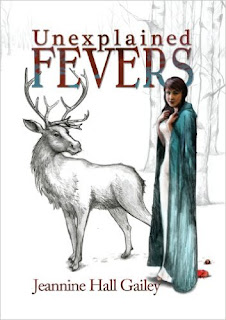
With that range of influences, I always find it interesting to see what she does with her books, which include Becoming the Villainess, She Returns to the Floating World, Unexplained Fevers, and The Robot Scientist's Daughter.

Among her awards, she she received a 2007 Washington State Artist Trust GAP Grant and she is a two-time winner of the Dorothy Sargent Rosenberg Poetry Prize (2007 and 2011.) She Returns to the Floating World was a Eric Hoffer Montainge Medal Finalist (2012) and received the  FPA President's Award for Poetry (2011). Two of her poems from Becoming the Villainess, "Persephone and the Prince Meet Over Drinks" and "Becoming the Villainess," appeared in the 2007 edition of The Year's Best Fantasy and Horror. She also took an "Honorable Mention" in the 2008 Mainichi Haiku Contest. She also served as the 2nd poet laureate of Redmond, Washington.

In addition to her poetry, she also writes book reviews, flash fiction, and occasionally creative non-fiction. She recently taught with National University's MFA program and the Young Artist Project at Centrum.

I was delighted she shared so much of her journey with me during our conversation, and I think there's much we can learn from her approach to speculative poetry and her literary journey.


Let's start from the beginning. When did you develop an interest in poetry?
I've been writing poems on a regular basis since about fifth grade, when a teacher encouraged me to try to write every morning before school and pointed me to Emily Dickinson and Carl Sandburg for inspiration. My mother also shared her college poetry textbooks (she was in college when I was in grade school) and that was very inspiring to me as well. Even before I tried to really publish much, I was writing regularly. I started sending work out regularly around 2002.

How would you describe your access to poetry growing up?

(Did I already answer that question above?) If not, besides the fifth grade teacher and my mother's college textbook (Introduction to Poetry by X.J. Kennedy used, circa 1969, if you're curious), I also participated in poetry recitation contests (my school was super nerdy that way!) and won a couple of years in a row with poems from e.e. cummings and Louis Simpson (his excellent "My Father in the Night Commanding No" is a terrific high-school kid poem), which encouraged me to continue to memorize and recite poetry. I used to carry a very tattered copy of Edna St. Vincent Millay to school with me in high school to read between classes. I also loved Edgar Allen Poe and T.S. Eliot, especially "The Raven" and "The Love Song of J. Alfred Prufrock."

Have you always been in Washington? What was your family's reaction to your poetic path?

No, I've lived all over. I was born at Yale Hospital in New Haven, Connecticut, where my father worked in research for early CT-scan machines, then we moved to LA, then Oak Ridge, Tennessee, where he worked at University of Tennessee and consulted at Oak Ridge National Labs. I wrote The Robot Scientist's Daughter (Mayapple Press, 2015) all about growing up in an "atomic city." Later we moved to Cincinnati where he taught at University of Cincinnati, which is where I went to get my undergrad in Biology and MA in English. I took a job in Richmond, Virginia, stayed there for a year, and then got an offer from Microsoft in Seattle, which I quickly accepted. I really did love working there, but got sick a little bit into my time there, and my husband encouraged me then to go get a low-residency MFA. I think that's when I really got serious about publishing as well as writing, and the Pacific Northwest is a wonderful place to be a writer - wonderful inspiring natural surroundings, a supportive writing community, and a great art-and-coffee-shop culture. (I had a quick flirtation with CA as an adult too - a year in Napa, and a year in San Diego.) So really, I've lived everywhere I've ever wanted to live except probably Boston and Paris.

My parents had encouraged me to study medicine - I was pre-med for my first degree. I finished the degree in three years, but ended up with some severe health problems, so medical school was off the plans for me as I recuperated. I ended up working as a tech writer - my mother was a technical writer for years - and going back for my MA in English while I worked full-time. I don't think this is probably the typical poet's journey - planning for one career, doing a second, and meanwhile writing the whole time - but that's how it worked out for me.


Which poem of yours do you usually recommend to someone who wants to read your work for the first time?

That's a tough one. I've been kind of in love with two poems from the new book, Field Guide to the End of the World, "Introduction to Disaster Preparedness" and "Epilogue." But if you really want a quintessential "me" kind of poem, then go with "Wonder Woman Dreams of the Amazon" from my first book, Becoming the Villainess.

Do you prefer coffee or tea?

I love tea, but became, if you can believe it, allergic to it in the last six years, and I don't drink a ton of coffee but I do love the smell and taste of it. I use coffee in cooking all the time! My husband the real coffee lover - he could probably tell you the best local places in Seattle to buy roasted coffee, to try a latte, or experience a particularly interesting brewing process. I love the coffee shops here for the community and the atmosphere - we are very luck to have a ton of great coffee shops nearby. I think bottling the smell of coffee and selling it a a perfume would be an excellent idea. I know I would wear it!

If you could have any imaginary being for a pet or companion, what would it be?

Oh, I think I have to go with flying telepathic time-traveling unicorn as shown in A Swiftly Tilting Planet, but if that wasn't available, definitely one of the Anne McCaffrey psychic-type dragons or even just one of her fire lizards.


You've had some exciting successes lately, including two second-place finishes for Book of the Year for Unexplained Fevers(2014), and The Robot Scientist's Daughter (2016) from the Science Fiction Poetry Association, as well as the release of your latest book, Field Guide to the End of the World, which received the Moon City Press Book Prize. Each goes into some very different territories of speculative literature. Can you tell us a little about your process for determining a focus for your manuscripts?

Thank you for saying that! I think we poets rarely think of ourselves as successes.

Each book sort of decides itself – this latest book started off with these odd postcards by a fictional person at the end of the world, along with the idea of syllabus-themed poems “Introduction to Ecotoxicology,” for instance. The academic-theme was sort of apocalyptic, and the post-apocalyptic postcard series sort of made a good counterpoint to the science poems, and that’s how that happened.

The Robot Scientist’s Daughter happened when I tried to write some truly autobiographical poems – a challenge I hadn’t really bothered with much before this book – and even though it did end up with a series of persona poems, it was a much more historically-based book than any of my others. (I still have a ton of books having to do with the cold war, the atomic age, Oak Ridge’s history, etc. Fascinating stuff!)

So I think each book sort of defines itself as I go – I don’t really start out with the idea of the book, I usually have an idea for some poems, and that idea develops as I write more and more poems. I do end up with very thematic books, but that’s probably because of the way I write – a series of poems on a certain theme or subject until I run out of energy.


When are you most often satisfied with a poem? What's the signal to yourself that the poem is finished, at least for the moment?

Sometimes a poem isn’t really finished until it’s in the final copyedit of a book manuscript, and I might still change a poem after that. Some poems are very malleable, and some come out completely finished. I don’t ever really feel completely satisfied with my poems – there’s usually something I’ll feel like changing after reading it years later. Is that terrible? Or just the nature of language – that we’re never completely hitting all the notes we want to hit?

Washington seems to inspire many poets and the writers of the fantastic and the imaginative. What catches your interest about the Washington speculative arts scene?

I’ve always thought Seattle was the inspiration for Frank Baum’s Emerald City, and didn’t Ray Bradbury live in Oregon for a while? And I got to see Ursula Le Guin read poetry and defend the reputation of speculative writing during a storm on the Oregon coast, which was grand. Of course lots of science fiction and fantasy writers are drawn to a place with fewer crowds, more grand mountains/volcanoes, oceans, crater lakes, medieval-type forests, odd buildings and weird-looking mushrooms. I really like the variety of writers out here, and I do feel there’s a bit more tolerance for the eccentric – be it in writing, art, or clothing/hair color – than other places. I’ve never really “fit in” anywhere I’ve lived, but it feels like a good place to not fit in, if you know what I mean. There’s a museum here run by Paul Allen – formerly known as the EMP, known now as the Museum of Pop Culture, which includes exhibits on rock music and science fiction – first editions of classic sci-fi novels, cover art, and great exhibits on Star Wars, Star Trek, and Game of Thrones. It’s a great place to wonder around if you’re a sci-fi/fantasy fan feeling touristy in downtown Seattle.


Everyone's dying to know: What does it feel like being a poet laureate of a city like Redmond?

I served as the second Poet Laureate of Redmond – they’re on their fourth now – but I had a lot of fun, especially working with the techie-poetry connection and working with the extremely talented young people at the high school and at the Redmond Library. Redmond is noted as a tech-friendly town – home to Microsoft, where I worked briefly, to the American headquarters for Nintendo and video game schools like Digipen. So it’s an educated and diverse populace, but not maybe as known for its artistic culture as, say, downtown Seattle. I felt the audience there was engaged in science and tech but felt alienated from literature, so I focused on the connections between those things. We talked about superheroes and anime characters and e-books, and things like Japanese poetic forms and poetry translations.

I feel lucky that I lived in a city that valued the arts to have a Poet Laureate program! I’ve recently moved to another town on the East side of Seattle called Woodinville – I’m hoping I can persuade them to start one as well! Seattle doesn’t have an official Poet Laureate program, but Washington State does, and I’ve been lucky enough to be friends with a couple of poets who served in that program. They travelled all over the state to promote poetry in different towns and environments, from the Pasco desert to Yakima wine country – truly, it sounded much more grueling that my gig. I encourage poets and people who care about poetry to show up with a plan to their own city councils and ask about setting aside a small budget and a small amount of time in their Parks and Rec programs for a Poet Laureate program! Poets can do a LOT with a small budget – for instance, I was able pay visual artists and show collaborations between artists and poets, as well as have in guest speakers to run workshops for teens. Why not? It benefits the population, the city and the reputation for culture in both small and large towns.

What are the ideal writing conditions and workspaces for you?

I can pretty much write anywhere I bring a laptop, and I've written a lot of poems of scraps of paper and receipts, backs of prescriptions, in offices, used car lots, in line at the supermarket...one of the places I write the most is where I spend a lot of time, unfortunately - hospitals and doctor's waiting rooms. Lots of spare time with nothing better to do and lots of stress = effective poetry writing. My new place (we just moved) actually has an office just for me, which is I think the first time I've had dedicated space in a long time. It's really nice!


What's been the hardest secret of writing for you to get across to your students?

That reading widely and deeply - in other subjects, other genres, etc - isn't something dangerous that will screw up their voice, but something necessary that will help them become better writers. No one should be afraid to read because it will "steal their voice" or "influence them too much." If you read enough, all the influences sort of blend together to help make your writing voice even more individual, nuanced, unique.

What has been one of your favorite readings?

I really liked seeing Margaret Atwood read. I think I remember she not only read, but she sang in her funny Canadian/midwestern twang. She also held really tight to her purse the entire time she was giving her lecture and reading. I also love hearing Dorianne Laux read, every time I see her.

What would you name your robot?

I'd probably name her after a character in Greek mythology. There's something so inherently tragic about being a robot, isn't there? Calypso or Cassandra or Calliope. All the robot characters I write are quite melancholy.

You can visit Jeanine Hall Gailey online at: http://webbish6.com/

Friday, March 11, 2016

Reality Adjustment, Alien Sex, Black Forests and F.J. Bergmann

F.J. Bergmann wears many hats in the world of poetry. I first became familiar with her work in the mid-2000s, and I read with her for the very first time at CONvergence in Minnesota in July, 2015, where she gave a very lively and assured performance. Over the years, I have come to appreciate her sense of humor, how seriously she approaches her poems as well as those of others, and her commitment to building a sense of literary community. Based in Wisconsin, she enjoys giving talks and presentations on poetry, as well as performing.


An award-winning poet, science-fiction writer, artist, and web designer, she maintains madpoetry.org, a public-service poetry site for Madison, WI. She  is heavily involved with the Science Fiction Poetry Association in multiple roles including the editor of Star*Line, the journal of the SFPA. Additionally, she is the poetry editor of Mobius: The Journal of Social Change.

Her recent accolades include the 2015 Science Fiction Poetry Association's Rhysling Award for the Long Poem, the WFOP 65th Anniversary Poetry Contest, the 2013 SFPA Elgin Chapbook Award, the 2012 Rannu Fund for Speculative Literature Award for Poetry, Heartland Review’s 2011 Joy Bale Boone Poetry Prize, and both the Theme and Poet’s Choice divisions of the 2010 WFOP Triad competition. She has also received an International Publication Prize in the 2010 Atlanta Review contest, won the 2009 Tapestry of Bronze contest, and won the 2008 SFPA Rhysling Award for the Short Poem.

I think there's a lot to learn from her, and thought it would be a good idea to have a conversation with her to get her perspective on literature and the journeys we've been taking. Be sure to visit her websites at http://fibitz.com/ and her journal at http://fibitz.livejournal.com/

Do you mind telling us when you first developed an interest in poetry? How would you describe your access to poetry growing up?

I remember reading some poetry in my single-digit years--my parents had a large anthology of warhorses, a book of Walt Whitman's poems, that sort of thing. Dr. Seuss and the poems in Alice in Wonderland, of course, as well as The Hunting of the Snark. And fairy tales, which I read avidly, often incorporated poems, frequently as incantatory devices, i.e., magical spells. It says a good deal, I think, that when I got married, the person officiating used the Whitman collection from my childhood as a prop.

Have you always been in Wisconsin? How did your family first react to your interest in poetry?

I lived in Paris, France, for two years of my childhood, but grew up in Wisconsin otherwise. I first wrote a poem in eighth grade, and I don't remember ever soliciting any input from my family, none of whom are poets. My husband, Fred, is an excellent first reader, however.

Which poem of yours do you usually recommend to someone who wants to read your work for the first time?

Well, I variegate in style and content a good deal. These two would be somewhat representative of the desired effects: "Grand Tour" and "Suspended Animation" 

Do you prefer coffee or tea?

Black or jasmine tea, with milk, sugar, and, ideally, delectable comestibles in elegant surroundings--and I must refer you to "Tea Ceremony," a poem triggered by being served, after I had requested tea, a styrofoam cup containing lukewarm water, accompanied by a generic teabag, artificial sweetener, artificial creamer, and ersatz lemon flavoring,


If you could have any imaginary being for a pet or companion, what would it be?

Probably a dragon, or any similar rideable flying predator. (I am fond of horses and have spent most of my life working with them professionally, but, as herbivores, they tend to be somewhat timorous.) I am somewhat tempted by the invisible sentient garrote/AI proposed in Zelazny's Amber novels, though.

You've had some exciting successes lately, including the 2015 Rhysling Award for Long Poem. How did “100 Reasons to Have Sex with an Alien” come about? And what might the 101st reason have been?

Well, as the epigraph suggests, 287 More Reasons to Have Sex, by Denise Duhamel and Sandy McIntosh, was the direct inspiration. Duhamel was a speaker at a state poetry conference and read from the (hilariously funny) book, which itself was inspired by an addendum to a research paper on reasons why people have sex. I basically tried to include all the genre tropes and SF cultural-lexicon references I could think of. There are nods to a lot of favorite authors, from Damon Knight to James Tiptree, Jr. As far as the 101st reason ... a Mata Hari-esque seduction in order to steal the secrets of FTL travel, I should think!


When we see you writing poems like "Anomaly" and "Transference," it's very clear you're comfortable working with either short forms or long forms. What's your process like in determining the style you use for a particular topic?

The poem ends when it has accomplished what it set out to do, which in the case of horror is best accomplished by leaving off the dénouement, and not explaining too much; in "Anomaly," a short series of disquieting images and events resulted in the feeling of an inescapable nightmare--and you know you always wake--or wish you could--at that moment of peak terror. In the case of "Transference," I was using a rather long list of filler words from a spam e-mail (I've used spam as a source for many poems), so of course I couldn't end the poem until I'd used up all the words.


You've done several chapbooks over the last few years, from 2003's "Sauce Robert" to "Out of the Black Forest" in 2012 with illustrations by Kelli Hoppmann. What are some of the important things you've learned about putting a collection of your work together? And will we see a full-length manuscript in the future?

My work is much more variable in style now than it used to be, so it's harder to assemble a cohesive manuscript, especially full-length. I've put together a number of other chapbooks, as well as longer books, but have not had luck finding a press yet (and have been remiss in submitting as much as I should--still trying to generate more spare time).

The poems in Out of the Black Forest were all written in a few months, all based on fairy tales. It had already been accepted for publication, and the publisher had been talking about finding an illustrator, when Kelli said, "I'm thinking of doing a series of fairy-tale paintings: do you have any fairy-tale poems?" I'd previously written a poem for Kelli to illustrate, and have subsequently written a number of ekphrastic poems based on her paintings (see http://the-toast.net/2013/12/13/three-poems-2/ and http://www.dansemacabreonline.com/#!fj-bergmann/c1xd5).

I now have two chapbook manuscripts based on Kelli Hoppmann-painting series, another chapbook of dark first-contact poems, a full-length SF manuscript, several other manuscripts that are more surreal, and am rapidly accumulating a book's worth of horror poems.

Wisconsin seems to be conducive for many poets and the writers of the fantastic and the imaginative. Of course, there's any number of theories and ideas why, but what catches your interest about the Wisconsin speculative arts scene?

Oddly, Wisconsin seems always to have been disproportionately represented in literature, especially when it comes to poetry (as evidenced by this quote: "More poetry is said to come from Wisconsin than any other state in the Union." Badger State Banner, 4/10/1885). I'd noticed, for instance, that the annual Atlanta Review poetry contest has a much higher number of Wisconsin poets as winners and finalists over the years than what one would expect from random distribution ( I've entered it 13 times, been published 3 times, and been a finalist 7 other times). A magician friend has theorized that the effect is due to a gigantic crystal of quartz underlying most of the state, whose visible peak constitutes Rib Mountain.

If you could adjust any part of reality without any ironic or unintenteded consequences, what would you start with?

Not allowing any media posts--online, social, or other--or political speeches without thorough fact-checking. That would totally transform the world!


You see a lot of trends come and go in speculative poetry as the editor of Star*Line, but what are some of the untapped frontiers at the moment, or some lines of poetic inquiry you think we're needlessly leaving by the wayside?

I enjoy riffs on the genre tropes and conventions we've come to know and love, but sometimes there's a dreary sameness about many submissions. There is a fine line between writing poems recognizable as genre and covering new ground; like all editors, I'm hoping to be simultaneously amazed and delighted. Send something no one's done before.

What's your ideal environment for writing? Is it much different from your environment for editing?

I don't care too much where I write or edit. Writing, in fact, seems to go better in noisy bars, or during meetings when I ought to be paying attention. I'm trying to work standing up a lot more, which pretty much limits me to the stand next to my desk. The one thing I don't do is play music. I like music, but my brain shuts down the ears when I'm in work mode.


You're wearing many hats these days, including that of poetry editor for Dark Renaissance Books. What are some of the ground rules you set for yourself as you consider the different types of manuscripts that come your way?

I indulge my own personal tastes, of course! Plus what's appropriate for the specific venue I'm dealing with. In the wake of the Hugo Puppy literary-vs.-genre discussions, I'll say that I feel very strongly that the two are not mutually exclusive. I have eclectic tastes, so I can't say that I'm drawn to any particular style or type of work. Like many editors, what I like isn't necessarily going to be the kind of thing I myself write.

Mobius: The Journal of Social Change is going into its 27th year in 2016. Orginally, it was established as an alternate to the corporate literary scene. As the world becomes increasingly connected, but also increasingly corporate-driven, where do you see the voice and vision of poets most profoundly needed?

I think poets and those who publish poets need to make an effort to place their work before those who aren't poets, who don't read poetry. Many who would remain unmoved by a diatribe or political statement will respond to the same sentiments expressed as a poem. A good poem, that is; I am not a fan of line-broken diatribes masquerading as poetry.


What's a skill that you've found unexpectedly useful on your path as a poet?

I don't think of them as skills; what looks like skill in writing poetry is really a willingness to do the basic background work to develop facility with language-wrangling. Three things, all indispensable:

1) Read. Read lots of stuff. Read classics; read award-winning contemporary work. Read way outside your discipline and tastes. Look up grammar and words you don't know.

2) Write. Spend time writing new work every day. Experiment. Try new prompts and forms constantly. Don't take it so seriously; it's impossible to write well without a sense of humor, aka a sense of the appropriate.

3) Solicit criticism, accept it gracefully and be willing to consider the advice offered. The more experience you have with critiques, whether they are from a crit group or beta readers, the better you'll be able to assess what your work is actually doing.


And finally: As a writer, have you ever had a poem "that got away?"

I have unfinished poems. I have poems that I've later deemed to be unsuccessful. But I pretty much retain control over what I'm doing. I think it's disingenuous for an author to claim that they don't. Writing on a roll, that's different. I've had poems and stories that came out all at once, in a blaze of incandescence. I could use a few more of those!

Wednesday, November 25, 2015

The Big Easy, Big Ideas, and Brandon Black


For some time now, I've had the pleasure of knowing Brandon Black, a New Orleans-based writer of fantasy and science fiction. He has the particular distinction of being the editor of New Orleans' first locally-written and produced steampunk and gaslamp fantasy anthology, New Orleans By Gaslight. 

He has a terrific sense of story that's inclusive and expansive, and his posts on other areas of genre always give me something to think about. He's one of the nicest guys I know, and I see many similarities between our experiences and influences growing up. I had the chance to interview him this month in the middle of his busy schedule of writing and making it all work out down in the bayou.

Be sure to visit his website at: http://brandonblackonline.com!

How did you get inspired to take up writing? Who are some of the writers who are enduring influences upon you?

My life has been woven through with stories. I learned to read from comic books. When we'd go over to my grandparents' house, I'd pull out this huge cardboard box of Golden Age comic books under my uncle's bed and just read for hours. I've never understood why they push such dry material on kids in school. Comic books got me to the point where I could read by the time I reached kindergarten and so they kicked me up into the first grade and even when I got there, I took reading class with the second graders. The Legion of Superheroes, the Avengers, the Green Lantern Corps and the Justice League are only a million times more interesting than "See Jane run."

My father was a physicist and he's the one who introduced me to science fiction (when I was a boy, he gave me an inflated astronaut instead of a teddy bear.) When I was old enough to understand it, we'd watch Doctor Who together on PBS. That's still one of my fondest memories of my father. But I'd have to say anime was the biggest early influence on me other than comic books. I remember the epic story of Space Battleship Yamato (Star Blazers here in the States), a crew of desperate young people making a trip of a hundred and eighty thousand light years, out to the Magellanic Cloud and back, in just one Earth year, with the goal of saving all life on Earth. That's a story!

I still remember that awesome moment in Robotech when I heard the narrator say, "Meanwhile, twenty light years away..." A transition. A simple transition between scenes and I was awestruck. This was a story of such scale, such scope that meaningful events were occuring simultaneously twenty light years distant from each other. I think that's when I started wondering if I myself could write science fiction.

As for authors whose work I revere, let's see: Larry Niven, Jack Vance, John M. Ford, Scott Cunningham, Louie Martinie, J. R. R. Tolkien, Grant Morrison, Alan Moore, Douglas Adams, G. R. R. Martin, and Neil Gaiman.

What’s your next big project you want to take on as a writer?

I want to write a huge sprawling epic of a novel. I want to write one of those three hundred and sixty thousand word books that panting for breath you can report to the police that you managed to bludgeon your attacker to death with because you had no other weapon with which to defend yourself.

I want to write a Great and Mighty Book worthy of Douglas Adams' line "and with a million sleek and horribly beweaponed star cruisers poised to unleash electric death at his single word of command..." Yes! That's the sort of book I want to write! But I'm not ready. I'm not ready as a writer and I'm not at the point where I would need to be in my career. I can't imagine there's a publisher anywhere that would take a three hundred thousand word novel from a new author. They'd insist on cutting it into three books and making a trilogy of out it and that would really just kill my enthusiasm for it. I want to write an epic work, an integral work that reads as a single novel from beginning to end, despite its length.

And there's that other annoying minor point that I haven't finished a novel yet at all. I have a steampunk novel that I'm writing and I need to finish it. Once it's done, then I can start looking to writing something longer.


New Orleans has a strong literary tradition. In what ways do you feel that’s impacted your approach to writing?

Rather than sound bitter, I'll just say that while New Orleans does have a very strong literary tradition and there are many people of letters who are passionate about writing and literature here, that doesn't mean they are passionate about science fiction and fantasy. I received little to no support or encouragement from my instructors or most of my fellow students in creative writing classes, save for Dr. Blackwood at LSU. The rest of my instructors at various points actively tried to dissuade me from writing science fiction. One of them, a full professor and at one point head of his college's creative writing department said that he didn't understand science fiction so he didn't allow his students to write it.

Can you imagine ANY other genre where an instructor, a full professor, could get away with saying something like that? "I've never really understood Westerns, so I don't allow anyone in my classes to write them." They would have laughed him off campus! In his defense, and I never thought I would say those words, I wound up creating the New Orleans Science Fiction and Fantasy Writers' Circle for much the same reason. I had participated, eagerly and productively, in a writers' circle at East Bank Jefferson Library but had begun to notice as my work progressed that increasingly comments from the rest of the circle had begun to taper off. Whereas I had before received useful criticism about this or that story and where it needed to be changed, particularly as I began to settle on steampunk as my genre of choice, criticism devolved into "good story as always." And while that's appreciated, it's not useful.

As for New Orleans' fandom, the difference between them and the ivory tower has been like night and day. Fandom's been incredibly supportive of my work going all the way back to when I wrote Star Trek fanfic for the Krewe of the Enterprise newsletter. I've given panels on steampunk at Mobicon in Mobile, CoastCon in Biloxi and I've been a regular guest at CONtraflow here in New Orleans for the past several years. Fandom's been very good to me and I appreciate it.

Fandom here is why I dream of making New Orleans a great literary mecca for science fiction. Starting the Writers' Circle and the By Gaslight anthology series are just the opening moves. What I'd like to see here one day is a thriving science fiction and fantasy literary society giving out its own yearly awards, a quarterly journal of fantasy and science fiction based out of New Orleans and a yearly "Best Of" of New Orleans' science fiction and fantasy. I want to give back to local fandom all it's given me.


Being a writer is a tough process, and this year has been a little more rough for you than most. Can you tell us a little about what’s happening? 

After Katrina, I evacuated to Hendersonville, North Carolina and then to Decatur, Georgia and finally to Mobile, Alabama. I lost my job in Mobile and moved back to New Orleans. My job search was pretty abysmal and so I hit upon the idea of making a go as a professional writer. I hadn't written much of anything in years and I had pretty much given up on the dream of being a full-time author. But I wasn't finding much in the way in the local job market, so I decided to buckle down and do some writing. And I achieved some great early successes. I had a story story published in Dark Oak Press' Dreams of Steam III and another in Seventh Star Press' A Chimerical World: Tales of the Seelie Court. I pitched the idea for New Orleans By Gaslight on my Facebook account and it's like the project slipped from my fingers and started rolling downhill from there. I was just entertaining the notion of doing an anthology and people were responding with "I've already started my story!"

New Orleans By Gaslight wound up being a big success, with the Times-Picayune running an article on the book and the East Bank Jefferson Parish Library throwing us a book release party. Things were looking good. But then, my health worsened and my car died. I should have put the brakes on trying to further my writing career and started looking for more conventional employment then. But I'd had this idea for a non-fiction book, something I'd been working on and off on since before Hurricane Katrina. I still had some savings and I was very confident about how my career was going and the profits that could be made from a nonfiction book. My researches had indicated that the industry standard was to pay an author an advance up front after accepting the book proposal and then work with the author to finish the book.

I was wrong. Very, very wrong. Publisher after publisher loved my book proposal. That too helped dig me deeper. Even when publishers declined to accept the project, they praised my writing and told me my book proposal was the best they'd ever read and it was only a matter of time before some company picked up the project. But no one did. At least, no one offering an advance. Months had gone by and the money I was counting on never came. Three publishers in the end contacted me interested in the book but none of them offered a cash advance and by that time, my financial need was pretty desperate. I couldn't even get an agent to intercede on my behalf. All my research had said that the easy, instant way to get an agent was to do everything yourself -- come up with an idea, write the sample chapters, identify publishers who printed material similar to what you were pitching, put together a book proposal and send it out to said publishers, all in the hopes of being able to say to an agent: "Look, I've got a publisher who's sent me a contract for my book, I just need someone to negotiate for me."

What I discovered was that if the publishers didn't mention a specific amount of money as an advance, that no agent was willing to take the gig. Their assumption was if they didn't offer X amount of money up front, the Y amount the agent might be able to convince them to part with wasn't enough for the agent to get out of bed for.

In the end, I was grateful to have an agent spell that out for me as too many other agents just said, "Great project but I don't think I'd be a good fit for it." I can't communicate the anger and frustration I felt, that I still feel, desperately needing money, having to turn to friends and family for my rent, for money for food and medicine, terrified of being homeless and all the while, sitting on a project that publishers and agents have said time and time again would be a lucrative success, is of great literary quality and worthy of publication, only to turn around and then say, "I don't feel like a good fit for it."


What are some of the great frontiers you feel more writers need to address in the coming years ahead?

Transhumanism is, as I see it, a great wall looming in science fiction's future. We're already living in the age of cyberpunk. We are fast approaching a time when people will be able to interface their brains directly with computers. I feel, at that point, that those people won't have much of anything in common with those of us who haven't experienced that and that that wall was and is a barrier to my literary interest. I can't imagine what it would be like to be a human being who could mentally slow time to microseconds and in that time, access the world's informational stockpile in order to make a decision.

What will a simple argument between boyfriend and girlfriend sound like when they both have computers in their heads downloading the internet? What will people care about, socially, politically, economically? When bickering about politics on Facebook is replaced with the instantaneous ability to fact check statements and download whole arguments, histories and philosophies in an instant, what will laws and human interaction even look like? What will entertainment look like? What will people care about?

Transhumanism offers to elevate humanity to godhood. And I suppose I'm too humble to want to write stories about real gods. When I do read and write about deities in fiction, it's humanized deities with goals and objectives and wants and desires that we as human beings have, not remote, incomprehensible abstract entities that have nothing in common with us because they've existed in some rarefied domain for millenia. When people move from being people to "being as advanced to us as we are to an amoeba" as Spock would say, how can we write about them? Why would you want to?

Bob argues with Rick about nth level transcendental hyper-dimensional tachyonic wave mechanics and how those wave dynamics replicate recurring patterns in hyper-time economics. Both Bob and Rick present computer simulations and studies based off those simulations -- that they've just now run in their heads -- to support their respective sides of the argument. I can't follow the argument. I can't follow their emotions. I can't follow their thought processes. An argument, a scene, that might change their lives forever might happen in the time I could blink. This crucible moment that led the two men to walk in different directions and work to change their society forever happened while I burped and tried to remember what I had for lunch. I don't know how to get past that wall.

What’s your advice for younger writers who are just getting started?

My advice to writers just getting started: Don't major in English. Don't pursue a creative writing degree. You can always take creative writing and literature classes as electives for another major. If you want to write science fiction, major in physics or engineering or computer science. You want a college degree that will help you put food on the table. You want a degree that will give you time and a comfortable lifestyle in order to write.

I majored in Military and Political Journalism and then got a Masters of Fine Arts in Creative Writing. I have only once in twenty years gotten a job specifically because of those degrees. All they've ever done for me otherwise was let me check the box next to "do you have a college degree?" on an application. By comparison, I knew a guy who got a four year computer programming degree and from the day he stepped off the college stage had a six-figure job, in his early twenties. That's more money in a single year than my parents made together any year of their lives. I knew another who worked in computers and made so much money that he only worked every other year to finance his bachelor's lifestyle.

My advice to you is to find a degree program that you'll be happy with that'll get you six figures and take creative writing classes on the side. Trust me. You'll be so much better off.

Monday, November 23, 2015

Two poems to appear in Uncanny Magazine in 2016

I was delighted today to receive news that two of my newest poems were accepted for Uncanny Magazine in 2016. In the meantime, be sure to check out their latest issue, which has some wonderful work in it, including new poems by Mari Ness, Sonya Taaffe, and Lisa M. Bradley!

For those of you who are curious, yes, these poems fall firmly in my ongoing Laomagination series. They'll involve some very familiar figures if you've been following my work since DEMONSTRA, but I'd like to think it's also not essential for you to be that familiar with Lao American and Asian mythology and folklore.

The rest will just have to be a surprise until it's published!

Thursday, January 30, 2014

Vietnamese science fiction and literary realism


In 2008, there was an interesting interview in the Vietnamese news with one of their leading science fiction writers, Vu Kim Dung.

One of the striking quotes to me from his interview was his idea that "to write science fiction, an author has to love both the social and natural sciences and be a skillful writer. Moreover, you should have a deep knowledge of social issues. As a writer, an imaginative mind is necessary to create interesting work. First begin writing short stories, then try with novels. You must combine scientific knowledge and literary skill."

I also found it interesting how he made an effort to have science fiction regarded seriously, when he remarked:
"Writing science fiction doesn’t mean basing stories on imagination alone. I have to study science and find scientific evidence. Then I work as a normal writer, finding context and making the stories interesting.

On the other hand, a writer must be creative and predict the future. That’s the big difficulty. The writer’s role is to create what hasn’t been invented. Writing on what already exists creates a story without value."
While I respect his position, I think that remains a key part of the difference between certain Asian nations' traditions and American speculative literature. This question of creating stories with value.

Certainly, there's a good deal of American speculative literature written with grand purpose and themes that make a comment on the human condition or seek to build a genuine love of the sciences, but there's also a great body of work that is is created without ulterior motive and grand purpose. Art that is indifferent to its value. That should be something of interest to us, this purity of effort where one has no illusions, no pretensions that what is written will change the face of arts and letters forever, yet one still creates.


I think many writers undermine their texts by trying to create something with 'worth' that ultimately goes into the dustbins of literary history because they become too much a product of their time.  There are some who succeed, but I think art can be extremely interesting when it can accommodate the truly unanticipated.

Vu Kim Dung's position on what science fiction and writers in general must do is something I'm taking note of: "The writer's role is to create what hasn't been invented," because it brings to mind, for me, Marx's classic assertion that "philosophers have only interpreted the world in various ways, the point is to change it".  I would hope that many officials within Marxist-inspired systems can appreciate this and give their speculative fiction writers the latitude to explore and to be ambitious, because good speculative literature does not have to be in contradiction with their value systems, but it will also thrive when it's given broad latitude to imagine.

Tuesday, January 28, 2014

"Full Metal Hanuman" honored by 1st Place in Strange Horizons Readers Poll.

In good news, my poem, "Full Metal Hanuman," with art by Nor Sanavongsay won first place in the Strange Horizons 2013 Reader's Poll.

"Full Metal Hanuman" originally appeared in September, 2013. A big thanks to all of our readers who voted for us! It's an honor, and certainly an exciting thing to wake up to in the morning.  You can find "Full Metal Hanuman" in my new book DEMONSTRA from Innsmouth Free Press.

I would definitely check out all of the poetry they've presented at Strange Horizons over the years. There are some pieces that are going to become classics. Among this year's other winners: "Lost" by Amal El-Mohtar, "Tattertongue" by Jenn Grunigen, "Jael" by Nancy Hightower, "Tataki" by Shweta Narayan and "I Am Learning To Forget" by Dominik Parisien are also poems you should check out.


I'm also going to give a big shout out to Sofia Samatar who's just on fire this week with her 1st Place fiction "Selkie Stories are for Losers" and 1st Place for reviews, and a 4th Place for her interview with Nalo Hopkinson. She'll have to clear off some space on the mantle for her new Crawford Award for Best Fantasy Debut, the novel A Stranger in Olondria. Seriously, read her book.

Monday, January 27, 2014

[Art] My Head II by Anousa Phommeuang


Anousa Phommeuang's "My Head II" which would sell for 1,500 euros. He's a graduate from the Fine Arts School in Vientiane based in Luang Prabang these days. According to his bio, his work has reportedly been "featured in exhibitions in Thailand, Singapore and other countries in SE-Asia," although more specific details than this were not readily available. Of his pieces available online, I consider this one his best. It is rough, but  it's his most imaginative with a competent composition. Like many of the Lao artists in Laos, he is heavily influenced by the cubism, surrealism, and expressionism forms that are still popular among the teachers and students there.

When we see the broader range of his pieces available, we see primarily traditional depictions of Lao women, particularly Lao women minorities especially common to the Fine Arts School in Vientiane. Within that range, several of his pieces are whimsical, others do a fine enough job paying homage to Picasso. But I find only his "My Head" series and "Circle of Life" (below) really step out into the individual and personal expression we would normally applaud in our culture.


"My Head II" in particular captures my attention because of the way it suggests a hierarchy of thoughts and interaction with the community. We see the fantastic and monstrous beast, monks approaching him, the women, and the others near his different sensory organs. It's a fun, imaginative visualization. I only hope one day we might see more pieces like this and that he has the opportunity to present really daring work that surpasses our expectations.

Sunday, January 19, 2014

Two poems selected for 2015 anthology, "How to Live on Other Planets: A Handbook for Aspiring Aliens"

Two poems of mine have been accepted for an anthology of immigrant science fiction. It definitely feels like a great way to start the week.


The anthology, presently titled How to Live on Other Planets: A Handbook for Aspiring Aliens, will be published by Upper Rubber Boot in 2015. It is being edited by Joanne Merriam.

The anthology sought narratives that explore the immigrant experience in a science fiction setting: what it means to acculturate, enculturate, assimilate or otherwise deal with living in a new place with strange inhabitants, customs, languages and/or landscapes.

I was fairly certain I had a few pages that could meet those requirements. The call for submissions is still open until January 31st, but take note that they are specifically looking for previously published work.


For the time being, I will keep it a surprise which pieces of mine were selected for the anthology. But I submitted a total of five for consideration earlier this year. But as a hint: Several of the candidates appeared in DEMONSTRA, Innsmouth Magazine, Lakeside Circus, and On the Other Side of the Eye. 

I wish Ms. Meriam the best of success as she goes through the remaining submissions and begins the long work ahead putting it all together. But it's an anthology many of us have been interested in seeing, and I look forward to the final result.

Saturday, July 13, 2013

Long Hidden call for Speculative Fiction due July 31st.

Long Hidden has issued a call for speculative fiction set between 1400-1920 C.E. with protagonists marginalized in their time & place. Due July 31. The pay is 5 cents/word. This one has a lot of potential and I strongly encourage you to submit material.

Wednesday, May 29, 2013

Concept: Alternate History of the Lao Secret War, with Lovecraftian Steampunk Zombies...

So, today in the workshop, I've been giving more thought to a concept of how to develop a story or poem regarding an Alternate History of the Lao Secret War through a Lovecraftian Zombie Steampunk lens.

Do we start it with Herbert West and his pals making a sidetrip to French Indochina? Or perhaps young Herbert West tried sourcing components for his serum from Lao botanicals in 1920s?

Because the mandate is to take it in new directions and to keep it subversive, punk and more than a pastiche, we need to consider alternate perspectives of how we could see the incident. Possibly, can we see it from the perspective of a shaman or Lao doctor at the time?

Where might we jump in with such a story?

"...he soon saw that the perfection of his process, if indeed possible, would necessarily involve a lifetime of research. It likewise became clear that, since the same solution never worked alike on different organic species, he would require human subjects for further and more specialised progress." appears close to the beginning, and provides us some clues of where we could take it, although the more likely point would be when West goes traveling after World War I.

The additional challenge is: What can we say interesting regarding this this material? At the present moment, I would say explore a Theravada Buddhist approach and worldview in counterbalance to West or his predecessor's assertion that life is a mechanistic, comprehensible process.  As I discussed in a recent poem of mine, "Digging for Corpse Oil," we might find the initial attitude towards someone like West's experiments are not strictly prohibited or horrific to the locals, so what would it require for them to take a dim view of such experiments? Or, how might they succeed where West and similar researchers fail?

Would French colonists or other foreigners be supportive, disruptive, or instigators? Or, should the story completely bypass them entirely and give the Lao more agency in this? What might prompt someone to explore reanimating the dead? Is it a response to the Jiang Shi tradition, or is there another reason why Lao might see the need to have a reanimated corpse around, even if it means unlocking forbidden knowledge?

How would the sudden presence of both steampunk technology and Lovecraftian process impact the path towards the Secret War for Laos? Would it avert it, or who would we see scrambling to master the science and magic first? Would the shamans of the various tribes suddenly become politically very valuable? But what would the cost of their alliance be? Would there be charlatans trying to get in on the act, who pay the ultimate price when their skills prove ineffective?

The story of the Toad King Khankaak who speaks of magic that humans abused until almost all life was wiped out might be an interesting legend to work with as we press forward with this. The Lao belief that the dead eat the vapors from food offerings might also be something to bear in mind while incorporating steampunk elements.

So, where do we add a truly transgressive taboo and where do we root horror from a Lao perspective? What are the unspoken customs and traditions that Lao would be horrified at seeing violated, without descending into mere gore?

Friday, November 02, 2012

Lao Steampunk: Airship designs?

I recently became a backer of the "Pulp" Strategic Airship Combat game set in a steampunk environment. We'll be following their heroine, Riva; a "formerly disgraced Commander of Dawns navy for voicing public opposition to her Commander The last hope in the conflict she lost everything to avoid, Riva returns to the sky to set things right, and to save Dawn from the promised annihilation by the invading Duskan forces."

I'll be submitting in a flag design of the famed Lao Airship Corps, the Flying Naks, of course, but it also got me wondering what the ship designs would look like based on historical Lao boat designs. I know, it sounds strange talking about boats, considering that Laos is a landlocked nation.


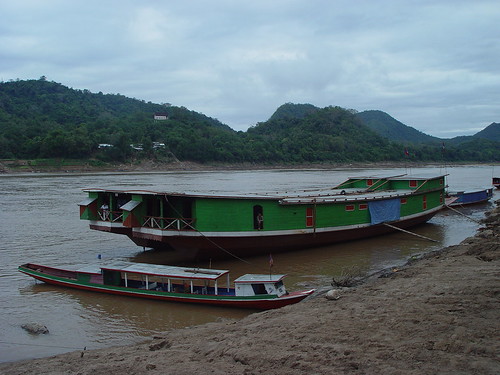
A great overview can be found at Boats and Rice. They point out: "For the most part, you can think of the variety of Laotian boats as simply different sizes of otherwise very similar boats: flat bottomed, with shovel ends, flaring sides, and quite long for their width. The smallest are about fifteen feet long usually, paddled with canoe paddles and have no motors. There is a large class of motor powered canoes ranging in size from about 18 feet long to upwards of 25 feet long."

It's not inconceivable that they could be ideal frames for airships, but there would also have to be more to it than just strapping balloons onto them.


With Lao terrain over 70% mountain and jungle, how would Lao society develop reliable landing strips and aerodromes? Would we see the major airbases still established in Vientiane, Luang Prabang, Pakse and Long Tieng? Would makeshift airfields such as the Lima landing strip models be used during the 20th century?

There aren't many references I've found that the Lao built elaborate boats such as the Thai royal barge the Anantanagaraj with its seven-head naga, or the Anekajatbhujonga. As a side note, the crew complement for the Anantanagaraj crew typically consistsed of 54 oarsmen, 2 steersmen, 2 officers, 1 standard bearer, 1signalman, 1 chanter and 7 royal insignia bearers. It's an impressive sight.

There are many questions we could ask about what role a parallel vessel would have in a Lao navy, let alone the Lao Air Corps.

Perhaps, in the retro-future, given the Lao relationship to the Nak, would they take a different approach to building vessels. The Nak traditionally are very protective of bodies of water, so, a story conceivably might suggest Lao who ply the rivers would do their best to reduce disrupting and upsetting the Nak through loud motors or pollutants.


The Nak have traditionally been in conflict with the Garuda, and I would see that still playing out in a world of airships. Lao might be more inclined to embrace the flying Vanon war monkeys or the Kinnaly in imagery on their air vessels in this alternate retro-future, as well as the classic Xang, although images of flying elephants brings to mind a certain Disney character.

These are just a few of the things to consider as one addresses transit in an alternate retro-future.

Sunday, October 21, 2012

Alternate Lao History

It's been a little while since we've done a discussion on Steampunk, alternate history and secret history especially from a Lao perspective. There are some perennial questions about the value of creating alternate histories when the real histories as seen from the perspectives of those who lived it are so hard to find to begin with.

So, if I tell you that in 2488, the Lao perfected a six-legged chicken but got bought out by a visiting Colonel Sanders who was serving in an advisory capacity for a foreign agricultural aid program with Pearl Buck, do I as a fiction writer need to feel responsible if someone believes that or spends time trying to debunk the idea?

Or: You haven't read Shakespeare until you've read him in the original Lao. That's always a great tall tale.

How interesting Lao American literature might become if we opted for the "Balderdash" approach to teaching our culture. To present utterly outrageous claims so often that we can only really hold onto our culture by doing enough research to know how and why those claims ARE outrageous.

Given how much the average Lao person knows of their own history right now, a 'straight' telling of our journey certainly hasn't gotten us very far.


In the meantime, here's something that may be of help for emerging Lao writers.

Largely adapted from the Martin Stuart Fox chronology of Lao history, and assuming the standard Asian zodiac, for those of you writing historic Lao fiction and other stories, the following can serve as a helpful guideline to get your chronological bearings.

The first year listed is the Lao year, the second year is the European/American calendar year:

1896: Foundation of Lan Xang by Fa Ngum. 1353, Year of the Snake.

2022: Vietnamese invade Lan Xang. 1479, Year of the Pig.

2091: Xetthathirat briefly unifies kingdom of Lan Xang and Lan Na. 1548, Year of the Monkey.

2103: Capital moved to Viang Chan from Luang Prabang. 1560, Year of the Monkey.

2106 to 2118: Burmese invasions of Lan Xang. 1563-75, Year of the Ox to Year of the Pig.

2181 to 2238: Reign of Surinyavongsa. 1638-95, Year of the Tiger to Year of the Pig.

2184 to 2185: First Europeans reach Viang Chan. 1641-42, Year of the Snake to Year of the Horse.

2250, 2256: Lan Xang splits into 3 kingdoms. 1707 and 1713,  Year of the Pig, Year of the Snake.

2322: All 3 kingdoms become tributaries to Siam. 1779, Year of the Pig.

2369 to 2371: Chao Anouvong’s war of independence.1826-1828, Year of the Dog to Year of the Rat.

2363 to 2383: Earliest Hmong migrations into Laos. 1820-40, Year of the Nak to Year of the Rat.

2404: French explorer Henri Mouhot arrives in Luang Prabang. 1861, Year of the Rooster.

2410: French Mekong Expedition maps rivers through Lao territories. 1867, Year of the Rabbit.

2430: Auguste Pavie, first French vice-consul arrives in Luang Prabang. 1887, Year of the Pig.

2436: French seize Lao territories east of Mekong, ceded by Siam.1893, Year of the Snake.

2442: Administrative reorganization of Laos under Resident Superieur 1899, Year of the Pig.

2444 to 2450: ‘Holy Man Revolt’ in Southern Laos. 1901-07, Year of Ox to Year of the Goat.

2450: Franco-Siamese Treaty establishes modern Lao borders. 1907. Year of the Goat.

2451 to 2453: Leu insurrection in Northern Laos. 1908-10, Year of the Monkey to Year of the Dog.

2457 to 2459. Leu revolt in Luang Namtha and Ho Tai revolt in northeast. 1914-16, Year of the Tiger to Year of the Nak.

2462 to 2465: Hmong insurrection in Northern Laos. 1919-22, Year of the Goat to Year of the Dog.

2466: First session of Indigenous Consultative Assembly. 1923, Year of the Pig.

2484: Franco-Thai war leads to Loss of Lao territories on the West Bank of Mekong. 1941, Year of the Snake.

2488: Lao independence declared. 1945, Year of the Rooster.

2493: US recognizes Laos as an independent state. 1950, Year of the Tiger.

2507 to 2516. Secret bombings of Laos. 1964 to 1973, Year of the Nak to Year of the Ox

2518: End of the War for Laos. 1975, Year of the Rabbit.

2555: Present day. 2012, Year of the Nak.

Saturday, September 01, 2012

Lovecraftian Laos: Aspects of Nyarlathotep

As we move closer to the H.P. Lovecraft Film Festival in Los Angeles on September 28-29th, I'm examining some of the interesting possibilities a writer has available to them setting a story in Laos incorporating the Cthulhu Mythos of early 20th century writer H.P. Lovecraft.

Today we're considering Nyarlathotep and the Nak, and to a lesser extent, the Nyak. 

In the glossary of On The Other Side Of The Eye in 2007, I explained that a nak is "Sometimes synonymous with Naga. Typically depicted as a many-headed giant serpent, as a river creature, and sometimes as a subterranean being. Nak are believed to help the Lao during wars, floods and are associated with fertility. Some say the Lao are descendants of a giant Nak living in the Mekong. To some, Nak are snake deities who converted to Buddhism and now protect the Buddhist Dharma. In art, they appear on the balustrades of temple causeways and platforms ("naga bridges"), personifying the rainbow, bridging the earthly and celestial worlds." The Tibetan parallel is Klu, but that's a discussion for another time.


Meanwhile, within the Cthulhu Mythos, there is the cosmic entity known as Nyarlathotep: 


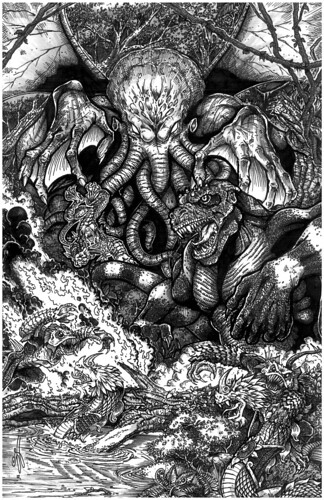
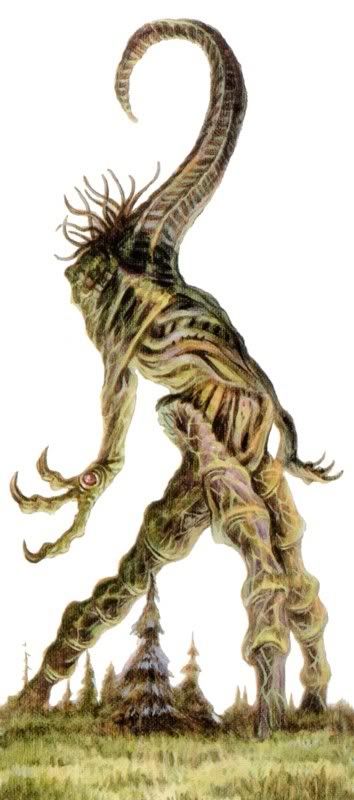
Nyarlathotep is an "Outer God" known by many names and forms, including the Crawling Chaos. First appearing in Lovecraft's 1920 prose poem of the same name, he was later mentioned in other works by Lovecraft and by other writers of the 20th and 21st century. The form above is often referred to as the Howler In The Dark.

Lovecraft initially wrote of Nyarlathotep as:

"...Nyarlathotep came out of Egypt. Who he was, none could tell, but he was of the old native blood and looked like a Pharaoh. The fellahin knelt when they saw him, yet could not say why. He said he had risen up out of the blackness of twenty-seven centuries, and that he had heard messages from places not on this planet. Into the lands of civilisation came Nyarlathotep, swarthy, slender, and sinister, always buying strange instruments of glass and metal and combining them into instruments yet stranger. He spoke much of the sciences - of electricity and psychology - and gave exhibitions of power which sent his spectators away speechless, yet which swelled his fame to exceeding magnitude. Men advised one another to see Nyarlathotep, and shuddered. And where Nyarlathotep went, rest vanished; for the small hours were rent with the screams of a nightmare."

Within the Cthulhu Mythos, the Outer Gods and Great Olds Ones are mindless entities of terror, not so much malevolent but indifferent to humanity. Nyarlathotep is distinguished from these because it is often considered cruel, deceptive and manipulative. Its role within this cosmology is to enact the will of the Outer Gods, serving as their messenger. It is more interested in causing madness over destruction, and is written of as an apocalyptic entity who will  most likely be responsible for destroying the human race and the Earth.

In the mythos literature to date, Nyarlathotep has appeared in Asia in numerous forms. In China, it can arrive as "The Bloated Woman." This form initially appears as a slender maiden behind a fan, but this fan is casting an illusion masking the true form of a large bloated tentacled humanoid that devours brains. In Malaysia, it has appeared as Shugoran, a black humanoid creature playing a horn who is summoned to punish others. It has also been known as "The Dweller in Darkness," "The Faceless God," "The Floating Horror," and "The Thing in the Yellow Mask." So what is one of its likely aspects in Laos?

As a shapeshifting entity, it would most likely appear as an iteration of a giant Nyak, similar to the Rakshasas of India and the Ramakien, magical, man-eating 'ogres'. The Nyak are feared for disturbing sacrifices, desecration of graves, harassing holy men and women, possession of human beings, and most other things we might expect of evil beings. I should note the Nyak are not always evil, and many took vows to protect the Dharma, the teachings of the Buddha in the White Lotus Sutra. The fingernails of a Nyak are often poisonous and their favorite food is human flesh and rotten food. In addition to being shapechangers and warriors, they are often illusionists and magicians.So this would be very consistent with an avatar of Nyarlathotep. In the Lao language might we see him referred to as Nyak Dam, The Black Nyak?

On the other hand, the Nak are not entities a Lao writer would present as villainous, because they are historically protectors of the Lao. (Of course, nearby mythologies take a different view of the Nak/Naga due to politics, etc. but that's not necessarily germaine to this discussion.) However, if we were to postulate how Nyarlathotep appears, it might come as Nak Dam, the Black Nak, which would be a blasphemous parody of the traditional form of the Nak.

If we were keeping consistent with prior appearances, Nak Dam would most likely appear with a tri-lobed eye, black scales, and numerous tentacles protruding from a number of obscene, terrifying heads. Based on Lovecraft's poem, we can speculate Nyarlathotep's aspect of Nak Dam would do similar things it does in Europe and America: Wandering the earth, gathering devotees by demonstrating strange, almost magical technology that eventually causes them to lose awareness of the world, of the passage of time, eventually leading to insanity and plunging the world into madness.

A protagonist in Laos or who is part of a Lao expatriate community might possibly try to fight Nak Dam by turning to the dham: the truths and lessons of the Buddha, and Lao customs to retain their sense of sanity. But would they succeed?

In such a story, would a Lao reader be terrified by the possibility that Lao culture and the lessons of the Buddha be irrelevant in the face of the powers of Nyarlathotep and these cosmic entities? How else might Nyarlathotep appear, in order to strike fear in the Lao? How might these themes be meaningfully explored?

The Lao, like many communities in Southeast Asia, are only recently becoming familiar with Western notions of psychology and sanity. This leads to an interesting discussion of how Lovecraft's recurring themes of the cosmic threats to sanity and an ordered, consistent sense of the cosmos may be an utterly alien topic of terror. One can almost imagine a Lao reader going "Ha ha ha. Oh. You lost the American version of your mind? That's it?"

So what do you tap in to that evokes an interesting sense of horror from a Lao perspective?

When you have a culture that lived through the American bombing that left 30% of the countryside covered in nearly 80 million cluster bombs, Agent Orange, and so many dead, maimed and displaced by almost half a century of conflict, what's scary anymore?

Monday, May 21, 2012

[Lao Steampunk] Steampunk Cthulhu

One of the interesting projects due at the end of July is submitting to Brian M. Sammon and Glynn Owen Barrass' Steampunk Cthulhu anthology for Chaosium. "The age of steam meets the age of Cthulhu, in a past where technology unbound warps Victorian Britain and the world at large into a dark Steampunk reality." is the overall aim.

So, I find myself preparing an all new short-story, wondering how to pull it off.  As much as I'd love to try it, I don't think I can do a Steampunk Cthulhu speculative poem justice at the moment. I should say, though, more than a few tongue-in-cheek titles have come to mind, such as the "Cogs of Cthulhu,""Anna and the King in Yellow," "The Steam Over Innsmouth," and "The Contraption Out of Space." It would be particularly apt to do a steampunk take on "The Fungi From Yuggoth" given that it was a long speculative poem from Lovecraft. Perhaps "The Last Brain to Yuggoth"?  Nah.

On a more serious note, however, these are some of the questions I find myself considering as we prepare such a story.

How do you successfully reconcile two seemingly contradictory genres. It's not the subjects. As we've seen with anything from Hong On the Range to Firefly, you can make space westerns work, for example. But to me the greater challenge is resolving the underpinning philosophies.


In Steampunk alternate history, most of the protagonists are outsiders who are alienated from the mainstream society. This is compatible with a Lovecraftian story. However, we find ourselves faced with a genre that typically positions the retro-future as a space where individual pluck, technology and science can overcome any obstacle to save the day. It's often optimistic noir with more than a tinge of romanticism and nostalgia for a by-gone era that never was.

Lovecraftian stories on the other hand, are compatible with Steampunk settings for the brooding, noir atmosphere of decadence and decay. But they also operate within a cosmos where there are things humanity was not meant to know, cannot know, without descending into cosmic insanity. Science, reason, human efforts are feeble and meaningless in the face of all of this. 

While both genres are capable of dealing with shades of grey, a Lovecraftian protagonist at best can hope to forget what they have encountered, or at least is going to be squished quickly by the end of the terror. So, what do we do with Steampunk protagonists operating under Lovecraftian conditions?

Of course, to create a good story that is appropriate to the theme I feel you have to navigate a fine line to avoid the criticisms of both genres. For Steampunk, the possibility of Empire-fetish, for Lovecraftian stories, the possibility of exoticizing and demonizing the Other, given his historic fear of foreigners and just about everything else under the sun. Steamcraft at its worst could be filled with many pro-Colonial stories of putting down subhuman, degenerate savage races. And that should raise eyebrows.

Since my hope is to turn in a Steampunk Cthulhu short story set in Laos, which once lived under French colonial rule during this era, there are therefore particular issues I consider such as the necessity to tell a story in which falang appear at all, or have to be acknowledged. With the 160 different ethnic communities that lived in Laos at the time, it's possible and perhaps preferable to create a lost tribe to serve as antagonists rather than use an existing one. 

For this story, I'd also rather keep away from noble-fetish, romanticizing the role of elites of the society. In traditional Southeast Asian literature, there's often a tendency to ignore the story of 'commoners' and everyday people in the narratives. It's almost always centered on the princes and princesses. Which to me goes against the 'punk' aspect of steampunk. Their protagonists often work best when they're NOT the ones supposed to be in power.

And of course, as I try to incorporate authentic or historically plausible elements into this work, I hope not to have the problem I had with 'The Journal Who Shall Not Be Named' that apparently had no problem dealing with shoggoths and deep ones, but suggested no one was going to buy into a race called the Hmong, among other issues.

But overall, I've found the process to be invigorating and enervating. With a limit of 8,000 words, it seems there's surprisingly little space for world development. I would say the breakdown thus far looks like: 25% world building and setting, 25% characters, 25% plot action, 25% technology and horror. But we'll see what comes out in the final equation.

How would you approach the Steampunk Cthulhu concept?