Saturday, December 24, 2016

On The Other Side Of The Eye: The Book turning 10


In 2007, my first full-length collection, On The Other Side Of The Eye was published by Sam's Dot Publishing of Iowa. While I can trace back much of my literary journey to 1991, and arguably earlier, but this is still one of the pivotal moments for me. 


The original cover was designed by Yuk Ki Lau, a friend of mine I'd met through my work with the non-profit organization, Asian Media Access in the early 2000s, and my book featured a foreword from Barbara Janes Reyes, which I appreciated very much. The reading for the book launch was held at the Loft Literary Center in Minneapolis. Among the readers who were a part of this were Katie Vang, Barbara Jane Reyes and Oscar Bermeo. My editor from Tripmaster Monkey, Mai Hoang, also came to attend all of the way from New York, and my publisher also came in person. 

The Hmong artist Seexeng Lee also brought along a unique painting for all of the guests to sign. Cakes by Fhoua made a cake for the guests inspired by the cover. This was all really exciting because it marked one of the first full-length collections of Lao American poetry in the United States. I thank all of the teachers who added it to their curriculum in the early years.
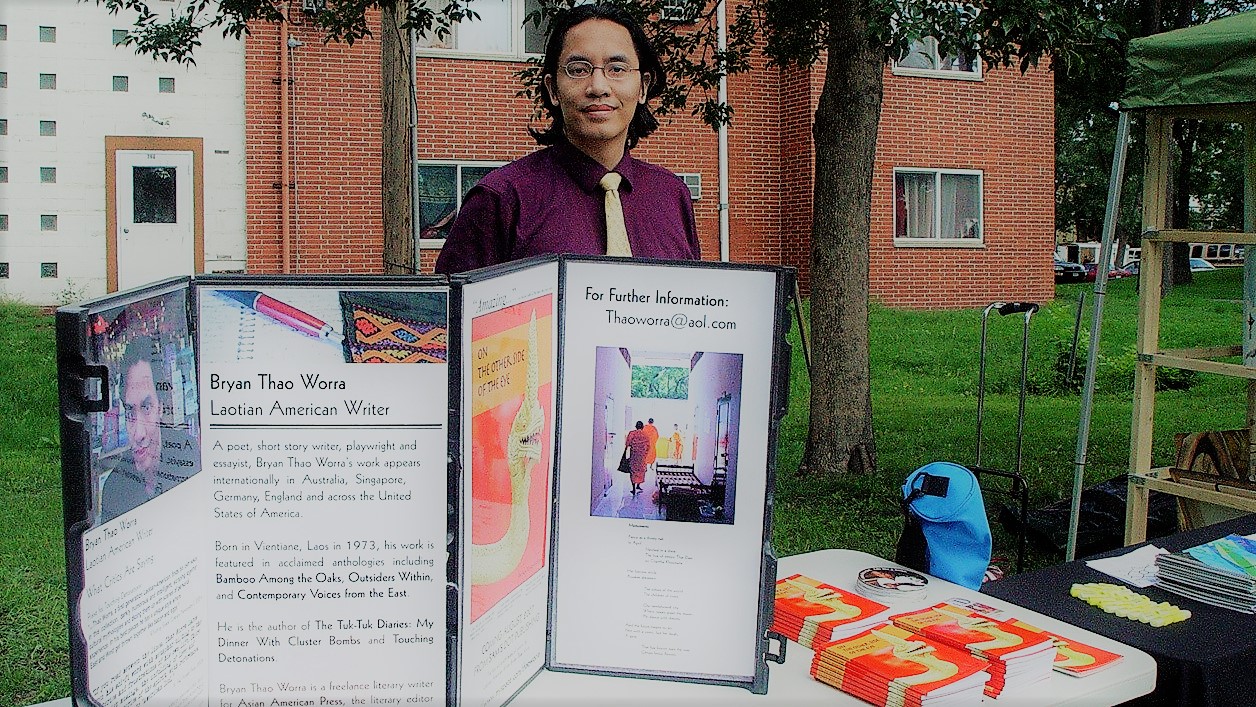

There was a lot to learn from the entire process. I still have a number of the previous drafts of the collections of my work I tried to get out into the world, including some entitled The Burning Mirror; The Lingering Bone; A Memory of Remains; and The Zen Labyrinth. I’m satisfied with the final results, of course.

Trying to figure out how you built an audience for Lao American poetry was a challenge because we really didn't have a baseline at the time. There weren't really any readily available resources I could turn to, so I was deeply grateful for the support of the Minnesota State Arts Board and the Loft Literary Center for their grants at this point that allowed me to experiment and find my audience. If you're in Minnesota, you absolutely ought to apply for these opportunities when they present themselves, and I think it's important to advocate for more support for such programs, especially among private foundations.


In the years since, I can now see where I developed more confidence to take risks and to try different ways of getting my work into other people's hands. You learn when it's good to give complimentary copies, and that you should always have at least five copies of your book with you or at least in your car whenever you go someplace. You learn the importance of making it easy for people to find your work. I also believe it's important to keep in touch with people, at least as a poet. Because a book is the beginning of a relationship with your readers and your community, not the end.

As I learned to understand what it meant to be an author with a book, On The Other Side Of The Eye taught me a lot about the journey of a writer. Over a decade, it has taken me to the Olympics, to an NEA Fellowship in Literature, the creation of the Lao American Writers Summit, and the presidency of the Science Fiction Poetry Association. It helped me understand what I wanted to do with my later books, and how we present them. I'm happy to see so many other younger artists and writers influenced by what I was trying to do with my first book, and I'm most pleased that I can still open it up and surprise even myself with what's written in it.

I plan to spend some more time in 2017 reflecting on specific aspects of this journey over the last ten years, even as I also take the next steps for my newest books development.

Friday, December 23, 2016

[Poet Spotlight] Burlee Vang


Today's Poet Spotlight is Burlee Vang, the author of the chapbook Incantation for Rebirth (Swan Scythe Press, 2010). He was recently selected by Mai Der Vang for Poem-a-Day on December 20, 2016 at the Academy of American Poets, and shared his poem "To Live in the Zombie Apocalypse," and discusses his journey in the interview Writing from the Absence: Voices of Hmong American Poets.


His prose and poetry have appeared in Ploughshares, North American Review, Alaska Quarterly Review, Massachusetts Review, Runes: A Review of Poetry, among other publications. His work has also been anthologized in Twentysomething Essays by Twentysomething Writers: Best New Voices of 2006 (Random House) and Highway 99: A Literary Journey Through California’s Great Central Valley (Heyday). In 2006, he was the recipient of the Paj Ntaub Voice Prize in Poetry.

I've always been impressed by his imagination and his poetic talents since I first came across his work while assisting the Paj Ntaub Voice. He has a unique gift and a love of the fantastic that made it very easy for me to feel a sense of connection with him. Over the years, I've watched him grow by leaps and tiger bounds into a great voice among Hmong poets with much to say to the world, while always taking joy in the speculative arts, unafraid to bring his culture and traditions into his work. One of my favorite poems of his remains "Muse of the Man Tiger."


He holds an MFA in fiction from California State University – Fresno, and is the founder of the Hmong American Writers Circle. As always, its significant to understand that although the Hmong trace their roots over 4,000 years ago to pre-dynastic China, they did not have a written language until the 1950s, and the Hmong creative literature arguably did not emerge until the late 1980s in the US.

In 2011, he, along with his brother Abel, were awarded a Nicholl Fellowship in screenwriting from The Academy of Motion Picture Arts and Sciences. He lives in Los Angeles with his wife, Mary, and their two children, Belle and Jude.

His first feature length film with his brother, Bedeviled, was released in October at Screamfest LA. Be sure to catch it if you love horror!

Thursday, December 22, 2016

[TBT] An interview with Mizuo Peck, 2007

10 years ago, I interviewed emerging actress Mizuo Peck for Minnesota-based Asian American Press. The interview appeared in March, 15th, 2007. This particular interview was thought lost for many years during a major server change for the paper that started pretty much from scratch. I'm currently in the process of recovering the interviews and articles that I can, including this one. She's gone in some great directions since, and was even able to reprise her role in later sequels to the Night At The Museum franchise.

New York-based Mizuo Peck recently shot into the spotlight with her role as Sacagawea in Ben Stiller’s comedy Night At The Museum, with Robin Williams, a monkey, and Dick Van Dyke. Many felt the half-Japanese actress stole the show in this holiday blockbuster. Previously, she appeared in New York stage productions, television commercials, and music videos, but is getting ready to take on even bigger projects. Asian American Press had a chance to catch up with her:


Asian American Press: How long have you known you wanted to be an actress?

Mizuo Peck:
I’ve wanted to be an actress since I was eleven years old. I was at TADA!, the professional Children’s Theater Company, singing and dancing till the age of 14.

Then I went on to study drama at Laguardia high school of the performing arts. I started dabbling in commercial work and modeling around 16 and became an official SAG member on my 18th birthday! I remember how excited I was to sign my own name.

Then it was off to SUNY Purchase to round out my education and get a BFA in theatre. I feel proud that I've always been so goal oriented and focused.

And yet, I also wish I had explored other things like sports, music, graphic arts, the Peace Corps, etc. Well I suppose I can start now... It's better late than never!

AAP: You really added a lot to Night At The Museum, even though you didn't get to say much. What were some of the interesting things you learned this time around?

MP: I learned so much from this film. Mostly about how important it is to be prepared and professional. I was working with so many great actors that I would’ve never wanted to be the one who dropped the ball. I really enjoyed doing all the research and preparation to play Sacagawea. She was an amazing woman in history.


AAP: Do you have any immediate projects you're going to be working on this year?

MP: I don't have any specific projects just yet. I do have some options and some scripts that have come to me but I haven't made any decisions. Perhaps I'm waiting for something better? I am in LA right now trying to book a pilot!

AAP: What are some your favorite movies?

MP: My all time favorite movie is Luc Besson's "La Femme Nikita". Whatta role! I love movies from the seventies like "Badlands" and "Clockwork Orange". I'm also a big fan of everything Tim Burton does.

AAP: What do you think audiences would be surprised to know about you? 

MP: I think they'd be surprised and glad to know that I am a regular girl just like them. Well maybe a bit kookier but definitely not like those perfect shiny stars they read about in magazines.

I try to stay healthy and active but I'm terrible at going to the gym. I like African dance classes! I drink coffee and eat cookies. I don't have a closet full of designer clothes and I love to visit my dad in Upstate New York so I can wear sweatpants and chop wood.


AAP: Do you have any advice for people thinking of getting into acting?

MP:
Don't do it! No, I don't mean that. Do theater and make movies because you love to and not because you wanna get rich and/or famous.

It's such a hard life of inconsistency that it's really not for everyone. And yet, on a personal positive note, with luck and perseverance dreams really can come true!

AAP: Has your family been supportive of your acting?

MP: My family is extremely supportive and psyched about my budding career. My dad lives in a small town upstate and has plastered my picture all over it. His gushing can get embarrassing at times but I know he's just so proud.

Everyone from the mailman to the guy who works at Radio Shack knows about my role in Night at the Museum.


AAP: Will there be any fun extras with you in the Night At The Museum DVD?

MP:
I hope there are! It would be great if they showed all of the different takes Robin Wiliams explored during our scenes together. He had me cracking up with all his off the cuff adventures in Africa stories and sexy hot wax jokes as I was melting his body back together.

AAP: What's the best thing someone's told you about your acting?

MP: I think the best compliment has been that I was strong and grounded in my role. For Night at the Museum, many people have said that I was graceful and gave the character depth.

AAP: Are there any words of wisdom someone's told you about acting that's sticking in your head these days?

MP: Luck is when opportunity meets preparation.

You can visit Mizuo Peck online at www.mizuopeck.com

Mizuo Peck today

Wednesday, December 21, 2016

2017 Southeast Asian American Studies Conference


The 2017 Southeast Asian American Studies conference will be held July 27-29, 2017, at the University of Massachusetts Lowell in Lowell, MA. The theme for this year's conference is "Community Engagement, Research, and Policy in Action." Their call for proposals is open until February 1st!

The 2017 conference will highlight Southeast Asian American communities in New England. Lowell, Massachusetts, is home to the second largest Cambodian American population in the United States, as well as Vietnamese, Lao, Burmese, and Bhutanese Americans. Nearby Dorchester, MA, and Providence, RI, are home to significant Vietnamese and Lao American populations, respectively.

This conference also seeks to build bridges across disciplines (humanities, social sciences, and sciences), and across/among scholars, artists, policymakers, and community members. What are the range of approaches to Southeast Asian American Studies? How might we foster communication and collaboration between fields and disciplines? What interdisciplinary approaches have been fruitful? What are some challenges to working across disciplinary boundaries? Given the opportunities and challenges of community-engaged research, what role can scholarship play in enabling social change for diverse SEAA communities? How can engagement with SEAA communities enrich and inform scholarship, and vice versa? We seek papers and panels from the humanities, social sciences, and sciences -- particularly in the areas of education, health, and public policy -- as well as from community organizations.

Since the first Southeast Asians in the Diaspora conference in 2005 at UC Riverside – which began as a conversation between scholars in Vietnam Studies, Southeast Asian area studies, and Asian American studies – the field has expanded into an established field concerned with a range of issues in Southeast Asian America. This conference seeks to build on this growth of Southeast Asian American Studies and continue to explore ways to work with communities, advocate for change, and formulate policy initiatives.